
MIIT's AI SME Entrepreneurship Support Plan Explained: An AI Startup Ecosystem Is Taking Shape
On September 4, 2026, the General Office of China's Ministry of Industry and Information Technology published the Artificial Intelligence SME Entrepreneurship Support Plan (2026–2028).
The document is numbered Gong Xin Ting Qi Ye [2026] No. 31. It was dated August 29 and sent to the authorities responsible for small and medium-sized enterprises in every province, autonomous region, municipality, city specifically designated in the state plan, and the Xinjiang Production and Construction Corps, asking them to implement it in light of local conditions.
Reading it merely as another policy that “supports AI companies” would understate its significance.
In seven pages and 15 specific measures, the plan addresses a larger question: as artificial intelligence moves from competition among a small number of model companies into broad adoption across industries, who will complete the last mile?
The answer is becoming clearer. China does not intend to rely only on a few foundation-model companies or large internet platforms. The policy seeks to cultivate AI SMEs, AI-native firms, agent developers, open-source entrepreneurs, AI application service providers, and even “one-person companies” and “super individuals.” Together, they can become the capillary network that takes AI into millions of enterprises and real industrial settings.
That is the central significance of the plan.
1. Start with the policy sequence, not the subsidy question
The meaning of an industrial policy often becomes clear only when it is placed in sequence with the policies around it.
In August 2025, the State Council issued its opinion on deepening the “AI Plus” initiative. It set a target for adoption of next-generation intelligent terminals and agents to exceed 70% by 2027 and 90% by 2030. The question was no longer whether China should develop AI, but how AI would enter science, industry, consumption, public services, and governance at scale.
The 15th Five-Year Plan then placed AI Plus inside a broader national framework for digital and intelligent development. It called for progress in multimodal AI, agents, embodied intelligence, and collective intelligence; encouraged AI-native businesses; proposed national pilot-scale bases for AI applications; and called for stronger digital enablement services for SMEs and a more developed open-source ecosystem.
Beginning in spring 2026, MIIT policy moved visibly into implementation.
In April, a program for inclusive computing sought to make computing resources easier and cheaper for SMEs to access. It referred to the China Computing Network Platform, SME service zones, “computing banks,” “computing supermarkets,” and vouchers for computing, storage, and network transport.
In July, an updated guide for small, fast, lightweight, and precise digital products defined the kinds of tools suitable for SMEs: affordable products that can be deployed quickly and solve specific problems, rather than large systems by default.
On August 31, MIIT published Document No. 414, a special action to cultivate AI application service providers. It set goals for a national provider pool of more than 2,000 by the end of 2026 and no fewer than 3,000 by the end of 2027. That policy asks who will consult, implement, operate, and govern enterprise AI.
On September 3, ten departments jointly issued the SME Development Plan for the 15th Five-Year period, bringing AI entrepreneurship, transformation, management, and services into the five-year SME policy framework. One day later, the AI SME Entrepreneurship Support Plan was published.
Together, the sequence is coherent:
Set national AI Plus goals → build computing infrastructure → cultivate SME-ready AI products → develop application service providers → expand the supply of AI startups → connect that supply with the needs of millions of SMEs.
The new plan is therefore not an isolated policy. It is building the entrepreneurial supply layer for China's AI application economy.
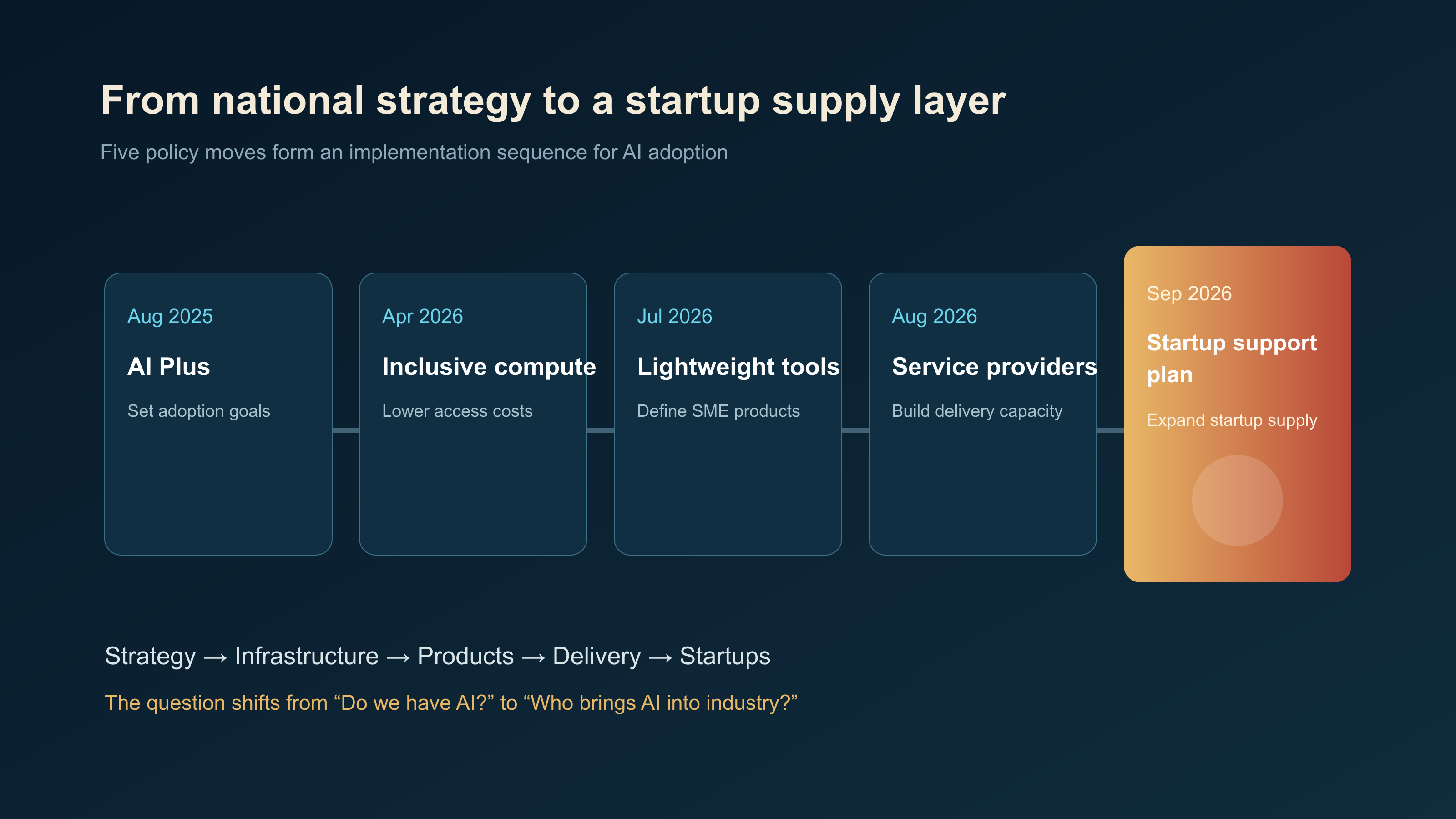
Figure 1. Five policy moves progress from strategy, infrastructure, products, and delivery to the cultivation of startups. Select the image to view it at full size.
2. The important change: policy now discusses one-person companies and super individuals
The most widely repeated sentence in the plan may be this:
Local authorities are encouraged to provide inclusive support for micro-entities such as “one-person companies” and super individuals that use intelligent tools for agile entrepreneurship.
It is immediately followed by another statement:
Accelerate the cultivation of AI-native enterprises and support emerging groups, including core contributors to open-source communities and agent developers, in exploring paths to commercialization.
These statements do not create a new business-registration category called a “one-person company,” nor do they mean that anyone using AI automatically qualifies for a subsidy. Their deeper meaning is that national policy is beginning to recognize that AI changes the smallest viable unit of enterprise formation.
In the past, starting a software business usually required a product manager, developers, designers, marketing, customer service, and operations. Today, one person who can use large models, agents, and automation effectively can theoretically mobilize capabilities that once required a small team.
The key idea is not the literal number of people. It is that one person may now work with a digital production team built from AI.
This is why the plan places one-person companies alongside AI-native firms, core open-source contributors, and agent developers. Its concept of an AI startup is no longer limited to a conventional software firm with an office, dozens of employees, and a complete organizational chart. Very small organizations may possess substantial capacity for knowledge work, software development, and service delivery.
AI-driven organizational productivity has entered national SME entrepreneurship policy in a direct and visible form.
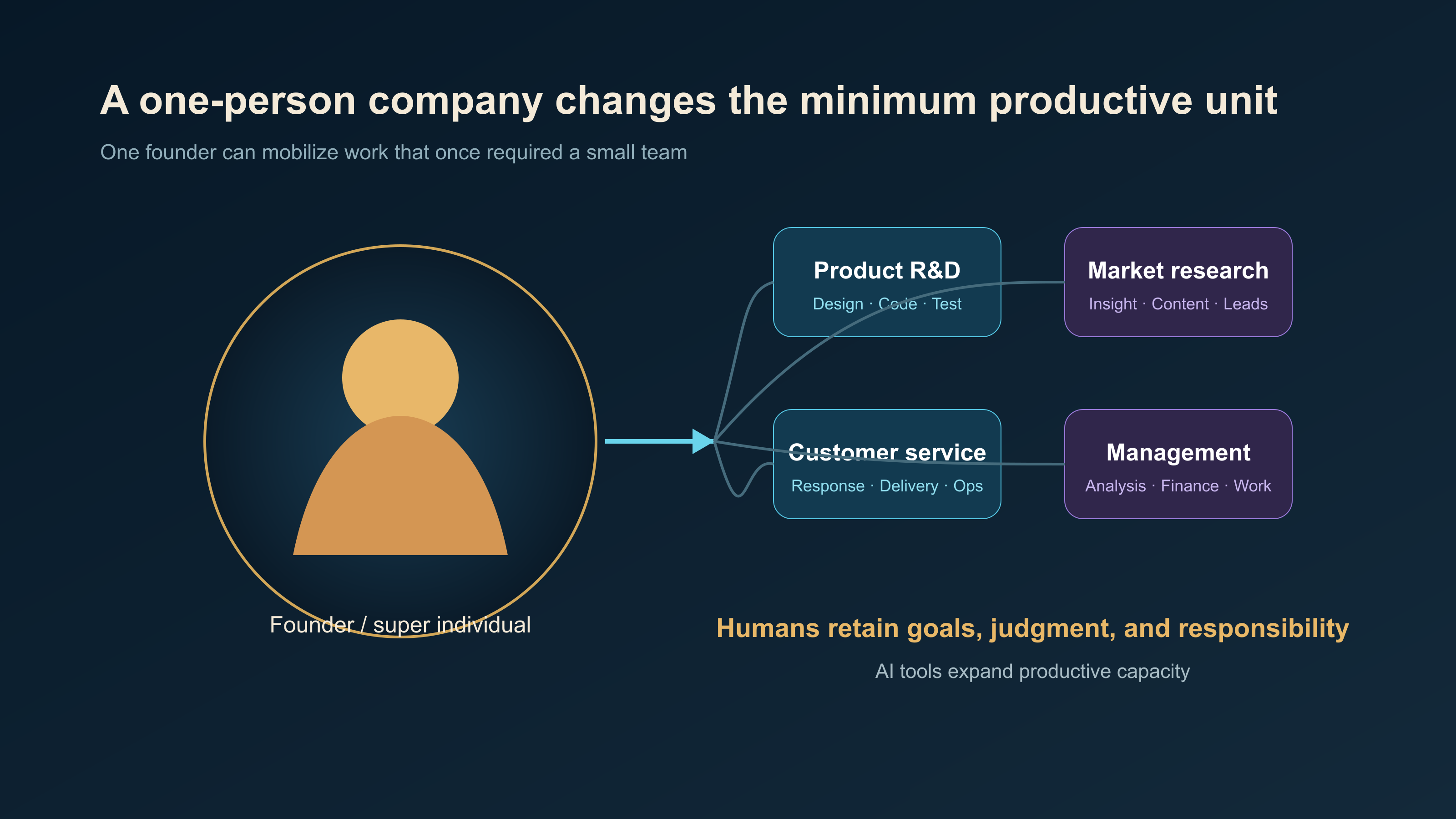
Figure 2. A one-person company's significance lies in expanding what one founder can produce with AI, while goals, judgment, and responsibility remain human.
3. Naming agent developers turns Agent from a feature into an industrial role
The words “agent developers” deserve particular attention.
The State Council's AI Plus policy already identified agents as a major form of intelligent application and set adoption targets for 2027 and 2030. MIIT now includes agent developers in a policy for cultivating entrepreneurial actors.
The first policy answers whether agents will become an important application form. The second begins to answer who will create them.
Together, they suggest that Agent is moving beyond a feature offered by model vendors and into an independent industrial ecosystem. One group supplies models; another supplies computing; others build agent tools and frameworks, create industry agents, deliver them to enterprises, and operate, govern, secure, and audit them after deployment.
This is also why Document No. 414 and the September 4 plan should be read together. Document No. 414 develops a delivery workforce of AI application service providers. The new plan expands the supply of innovative AI ventures. One addresses delivery; the other addresses entrepreneurship and innovation.
China is organizing more than a large-model industry. It is forming a service chain around the application of AI.
4. The policy builds both AI supply and SME demand
An easy-to-miss sentence near the beginning defines the plan's economic structure: it seeks to combine innovation by AI SMEs with the use of AI to support the high-quality development of SMEs more broadly.
On one side are AI SMEs. They need markets, computing resources, data, finance, and real application settings.
On the other side are China's very large number of ordinary SMEs. They need AI to reduce cost, improve productivity, and strengthen R&D, production, sales, and management.
The policy seeks to connect the two.
It calls for a group of small, fast, lightweight, and precise AI solutions for core business fields such as management, manufacturing, and R&D. It also calls for a virtuous cycle between SMEs exploring AI applications and AI SMEs pursuing innovation.
This means that one of the largest AI markets may not be consumers buying one more chatbot subscription. It may be millions of SMEs purchasing modestly priced, narrowly scoped products and digital workers that solve operating problems directly: procurement assistants, sales agents, customer-service agents, R&D assistants, quality analysis, document processing, market intelligence, finance support, knowledge management, and supply-chain analysis.
A large enterprise may procure a digitalization project worth tens of millions of yuan. A small manufacturer will not. It may, however, pay thousands or tens of thousands of yuan per month for a few AI systems that actually work inside its processes. At sufficient scale, this becomes a market very different from traditional enterprise software.
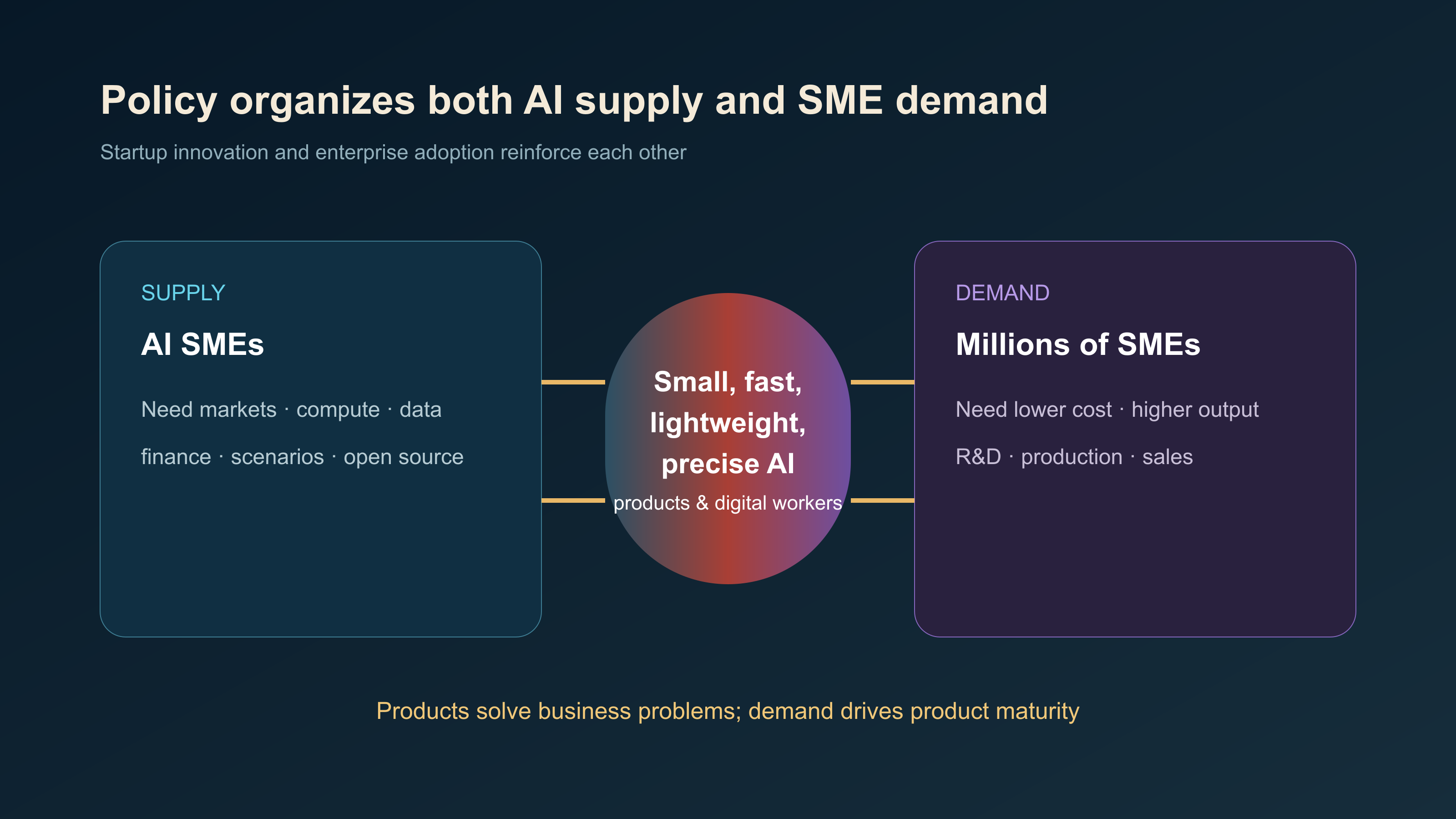
Figure 3. AI ventures provide focused products, while real SME needs drive those products toward maturity.
5. The hardest startup problem is not technology, but the first customer
China does not lack people able to build AI products. The harder question is: once a product exists, who will let the startup test it in a real setting?
In manufacturing, medicine, materials, and other industries, data, processes, and test environments are usually controlled by incumbent organizations. A technically capable startup may still lack real data, a representative environment, industry customers, and any opportunity to prove its product.
The plan therefore devotes considerable attention to application scenarios. Through activities connecting large and small enterprises and campaigns for AI-enabled industrialization, it asks leading enterprises to open settings for experimental validation, demonstration applications, and scaled commercial use. It also proposes selecting “AI entrepreneurship scenario partners” that can help startups identify scenarios, analyze needs, conduct pilots, and promote adoption.
The three stages matter:
Experimental validation → demonstration application → scaled commercial use.
This is more than holding another startup competition. It attempts to create a route into the market.
The plan also says that incubators should move beyond providing inexpensive office space. Computing, industry data, and application scenarios should become core services. For an AI startup, these resources may be more valuable than a low-rent office. The practical questions are whether it can obtain a model, computing, real data, a customer willing to run a test, and eventually a first order.
Entrepreneurship support is being redefined around those constraints.
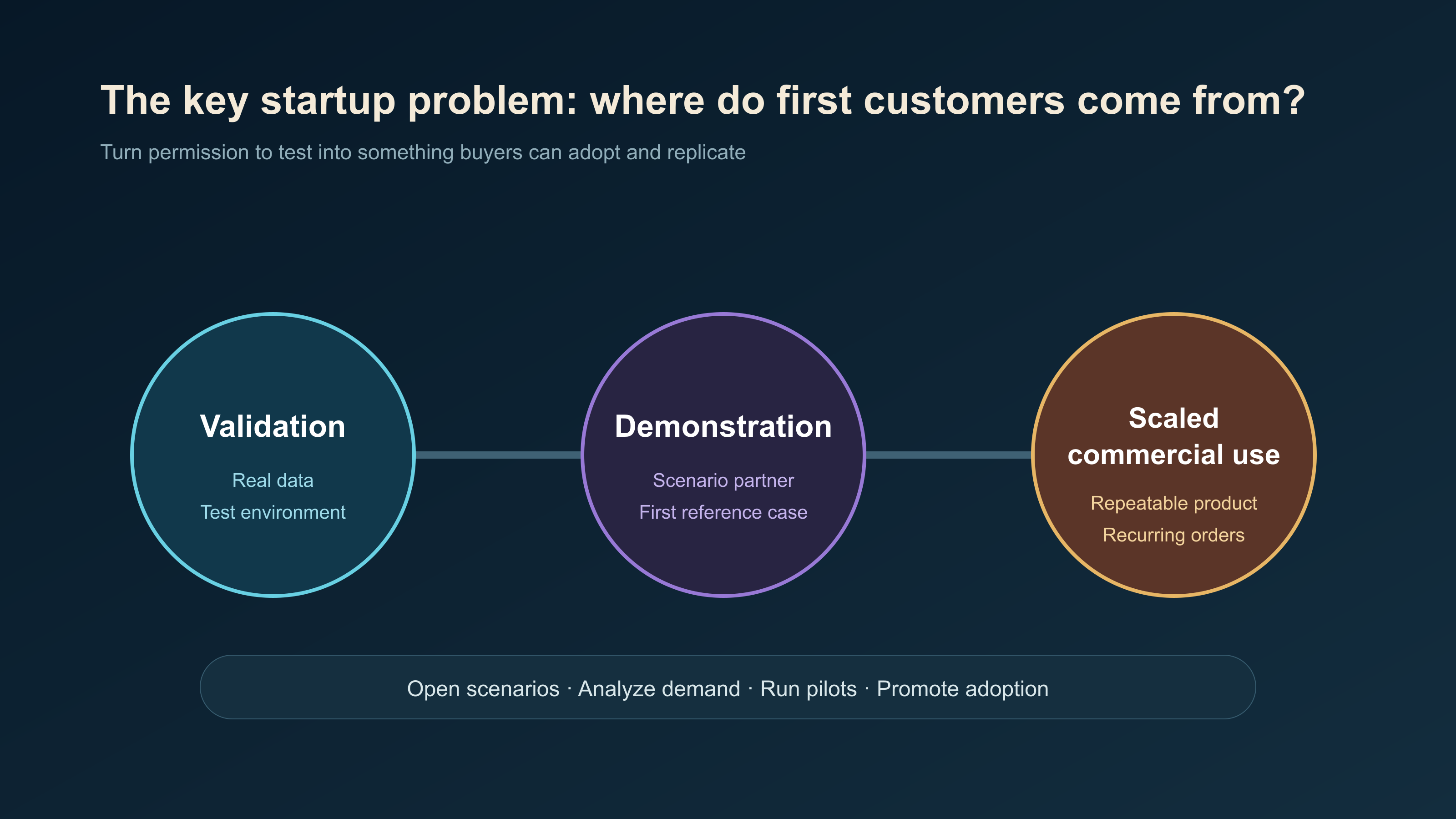
Figure 4. The plan tries to turn real application settings into a market-entry route: validation, demonstration, and scaled commercial use.
6. Open source is becoming infrastructure for AI entrepreneurship
The plan makes “deepening open-source ecosystem enablement” one of its four major work areas.
It calls for support for a national AI open-source community; contributions of models, tools, and datasets; adoption of open foundation models, development frameworks, toolchains, and datasets; services for model selection, fine-tuning, performance evaluation, and inference deployment; software, vertical models, and industry solutions built on open-source results; and mechanisms for commercializing those results.
The emerging policy judgment is clear: not every AI startup should rebuild a foundation model from scratch.
A more sustainable industrial structure has a small number of companies investing heavily in foundation models and infrastructure, with many more firms using open models, tools, and data to build engineering systems, products, agents, and industry applications. Mature foundation models lower the entry threshold above them. Richer open-source resources let small companies enter the market faster.
Open source is therefore no longer treated only as a way to develop software. It is beginning to act as public infrastructure for an industry.
7. A new signal: open-source stars enter the government's view of company discovery
The final part of the plan contains a detail that technical entrepreneurs should not overlook. It asks SME authorities to use AI and big-data analysis, together with indicators such as leading talent, invention patents, highly cited papers, and the number of stars on open-source projects, to identify high-growth-potential companies proactively.
Two phrases matter.
The first is open-source project stars. Observable influence on communities such as GitHub and AtomGit now appears directly in policy language about identifying growth companies.
The second is proactive identification. The traditional route into a government cultivation program required an enterprise to find a notice, prepare documents, submit an application, and wait for evaluation. The new wording suggests that public service systems may increasingly use publicly available signals to discover promising firms.
Patents, papers, talent, and open-source projects are all signals. This does not mean that a high GitHub star count automatically makes a company a specialized and innovative enterprise, or that stars lead directly to subsidies. It means that open-source influence now has formal visibility in policy.
This matters for software, development-tool, agent, and infrastructure startups that may have low early revenue, few employees, and little fixed capital. Traditional industrial metrics can miss them. Code contribution, project influence, and developer ecosystems may reveal their technical value earlier.
8. The plan gives specific three-year targets
By 2028, the plan aims to:
- cultivate more than 10,000 new technology-oriented and innovative SMEs;
- bring the number of specialized and innovative “Little Giant” enterprises in AI to more than 2,000;
- establish 10 high-standard technology business incubators;
- establish 10 national SME public service demonstration platforms or bases; and
- cultivate 10 national-level distinctive SME industry clusters.
For context, MIIT has reported that since the beginning of the 14th Five-Year period China has cultivated approximately 17,600 Little Giant firms, more than 140,000 specialized and innovative SMEs, and more than 600,000 technology-oriented and innovative SMEs.
Setting a separate target of more than 2,000 Little Giant firms in AI is therefore not merely a headcount target. It places AI inside the national ladder for cultivating high-quality SMEs.
Nor does the policy expect these companies to remain small startups forever. Its intended progression is explicit:
Entrepreneurial entity → technology-oriented and innovative SME → specialized and innovative SME → Little Giant → gazelle and unicorn.
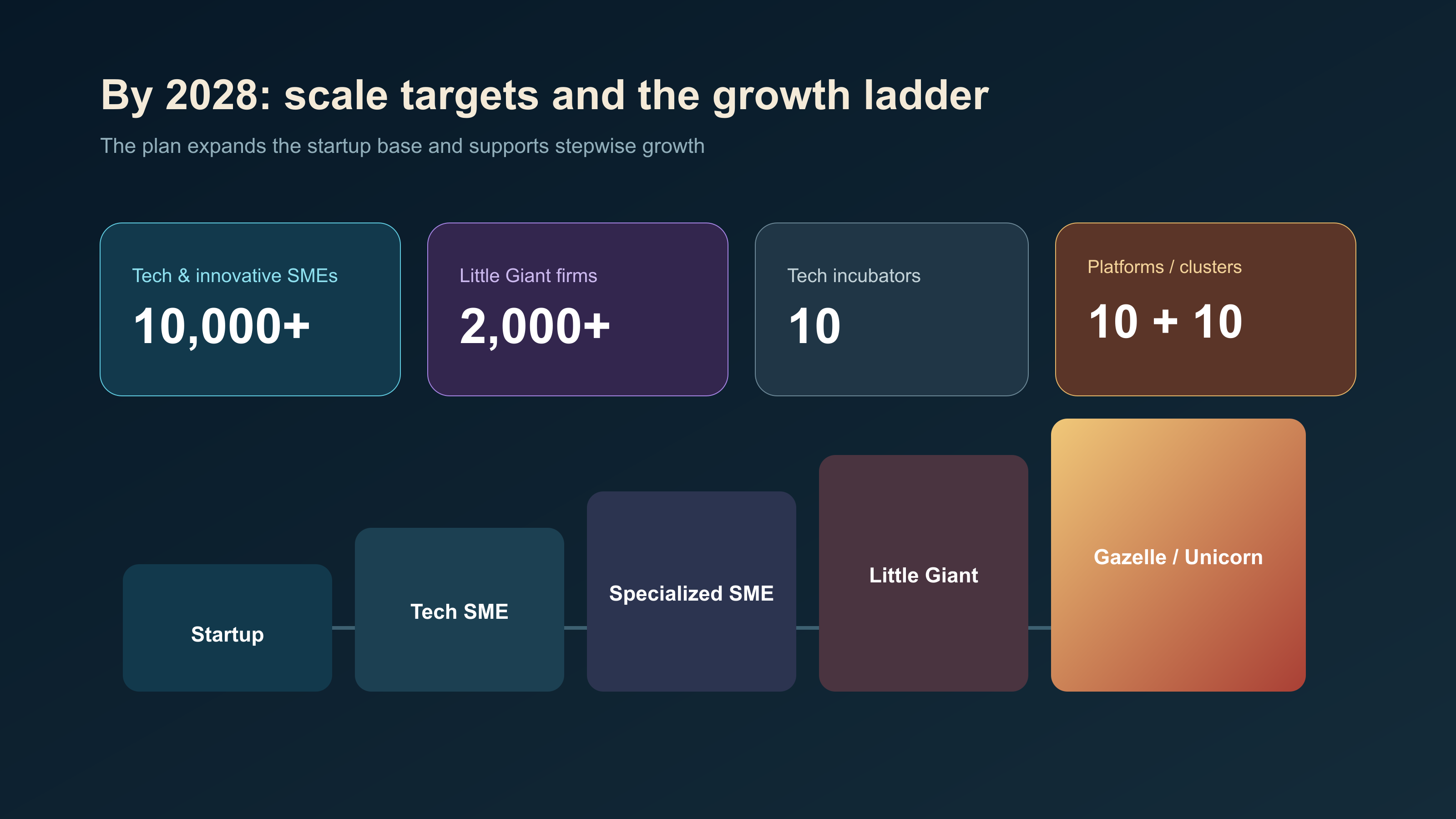
Figure 5. The three-year quantitative targets sit alongside a growth ladder from startup entities to gazelles and unicorns.
9. Support is moving beyond a single fiscal subsidy
The plan calls for a guiding role from the National SME Development Fund, the National AI Industry Investment Fund, and the National Integrated Circuit Industry Investment Fund. It also seeks to mobilize private capital across seed, startup, and growth stages.
More unusually, it proposes exploring computing contributions as equity, data contributions as equity, and investment-incubation coordination.
AI companies have a different cost structure from many traditional firms. Their largest costs may be tokens, GPUs, data, model invocation, testing environments, and access to industry scenarios rather than land and factories. Policy support must therefore address different productive inputs.
For an early AI venture, RMB 500,000 of computing resources, a high-quality industry dataset, six months in a real operating environment provided by a large enterprise, and seed capital may be more useful than conventional support tied to physical premises. The evolution of policy instruments follows the evolution of the industry itself.
10. Why cultivate AI SMEs when large technology companies already invest heavily?
Foundation models cannot solve every industry's last-mile problem.
China combines a comprehensive industrial system with an enormous number of SMEs. Bringing AI into those organizations requires detailed knowledge: how an automotive-parts firm conducts quality inspection, how a chemical company procures materials, how an export business manages customers, how a machinery factory quotes work, how a logistics firm schedules shifts, or how a materials company reviews R&D literature.
A handful of foundation-model firms cannot solve all of these problems. Thousands of companies must experiment across narrow sectors.
That is the role of SMEs. They do not compete mainly on foundation-model scale. They compete through scenario innovation and business-model innovation.
The intended structure may therefore be:
- foundation-model companies provide the base;
- computing and data infrastructure provide shared resources;
- large numbers of AI startups create products;
- AI application service providers complete delivery; and
- millions of SMEs become the application market.
That is the industrial structure required for AI Plus to reach broad adoption.
11. For Agent entrepreneurs, the opportunity is unlikely to be another chatbot
From an entrepreneur's perspective, the plan increasingly favors products that can enter real industrial processes, keep working, be deployed and delivered, support continuing operations, and meet governance requirements. It does not reward an AI demo merely for existing.
This explains why the same document discusses agents, SME-ready products, industry applications, service providers, data, computing, security, compliance, intellectual property, scenarios, open source, and financing. Together, they form an AI production system.
For infrastructure such as CodeFlowMu and FCoP, the policy direction also points toward a market question. Once enterprises deploy digital workers, attention moves from “How intelligent is the model?” to “How does this digital worker keep operating?”
Does it have an identity and defined responsibilities? Which tools can it invoke, and who authorizes those invocations? How are errors recovered? How do multiple agents coordinate? How is the process audited? Who accepts the result? How are enterprise data and permissions protected?
Foundation models do not automatically solve these questions. As models mature and agents enter enterprises, the importance of infrastructure for agent operations, coordination, governance, audit, and security is likely to rise.
This remains an analysis of policy direction and industrial structure. It does not mean that any particular project has been included in a national support program. Application conditions, evaluation standards, and local implementation still depend on subsequent formal rules.
12. The main development is an industry being organized, not a single subsidy
The easiest question to ask is how much money the state will provide each AI startup. The plan does not answer that question. It is not a specific subsidy application notice and provides no uniform grant amount.
Its larger purpose is to organize an AI entrepreneurship ecosystem: where computing comes from, how data is opened, who supplies real scenarios, which new entrepreneurial actors are recognized, how agent developers and open-source contributors commercialize their work, who delivers products, how capital participates, how compliance is handled, and how public services discover promising companies that are not yet well known.
The plan describes its objective as a “tropical rainforest” ecosystem for entrepreneurship and innovation. A rainforest is not a single giant tree. It contains large and small organisms occupying different layers and supporting one another.
China already has large model companies, internet platforms, telecommunications operators, and computing infrastructure. The next wave may consist of small, specialized firms close to industry sites. Some will have only a few people. Some may have one person supported by many agents.
Conclusion: from the large-model race to adoption across millions of enterprises
For several years, AI competition was often judged by model parameters, benchmark scores, financing, and GPU holdings. These remain important, but the direction of national policy is changing.
The State Council established AI Plus in 2025. The 15th Five-Year Plan placed AI on the main path of economic and social digital development. Computing, open source, SME-ready products, application service providers, agent developers, and AI startups are now being organized one by one.
China's AI industry is entering a second stage: from asking who can build the model to asking who can bring AI into every industry.
The scale of that stage will depend not only on a few dozen large model companies, but also on thousands of application service providers, more than ten thousand AI startups, hundreds of thousands of developers, and millions of SMEs that may use their products.
The plan does more than repeat that AI matters. It begins to answer a practical question: how can ordinary entrepreneurs, developers, and SMEs become active participants in the AI economy?
Terms that rarely appeared in national industrial policy—one-person companies, super individuals, AI-native enterprises, agent developers, and open-source project star counts—now appear in an official ministerial plan. That change may matter more than any single subsidy.
Principal sources and interpretation
- MIIT notice issuing the Artificial Intelligence SME Entrepreneurship Support Plan (2026–2028)
- MIIT special action on inclusive computing for SMEs
- MIIT explanation of the SME Development Plan for the 15th Five-Year period
Industry implications and stage forecasts in this article are analytical judgments based on public policy documents. They are not commitments regarding eligibility or funding. Actual conditions, timing, and local implementation should be determined from subsequent formal notices.