From SaaS to SaaW: When a Codebase Starts “Developing Itself”
A Manifesto for the Digital Employee Paradigm Grounded in TMPA Governance and CodeFlowMu Practice
1. The last mile that SaaS never solved
For the past two decades, SaaS changed how software is delivered.
Enterprises no longer buy software on discs, maintain large fleets of local servers, or pay the same deployment cost for every version upgrade. The browser became the entry point, cloud became infrastructure, and subscription became the business model.
But one thing barely changed:
Humans still operate software.
Employees log into ERP systems to query data and copy it into spreadsheets; open CRM systems to complete customer records; submit expenses in finance systems; approve requests in OA systems; and then move the result into yet another system.
The more software an enterprise owns, the more software its employees have to operate.
SaaS solved how software is delivered, but it did not truly solve who performs the work.
Copilot moved the boundary forward.
AI entered software interfaces to help humans draft emails, summarize documents, generate code, search knowledge, and support decisions.
But the basic relationship remained unchanged:
AI gives advice; humans perform the work.
Humans still sit in front of screens, clicking buttons, switching systems, entering results, and handling exceptions.
The next generation of software worth discussing should not merely be a smarter tool. It should be:
software capable of performing work.
We call this paradigm:
SaaW — Software as an Agent Worker
Software is no longer only a service.
Software begins to become the actor that performs work.
2. From buying tools to deploying digital employees
The core change in SaaW is not simply embedding an Agent inside SaaS.
It changes the basic unit of software delivery.
SaaS delivers functionality.
Copilot delivers assistance.
SaaW delivers work.
A real SaaW should not be merely a chatbot with a system prompt.
It needs a structure closer to a real job:
- a clearly defined role;
- clear job responsibilities;
- executable workflows;
- callable skills;
- bounded permissions;
- persistent work state;
- verifiable work evidence;
- a recoverable runtime environment;
- explicit human authority boundaries.
We therefore define SaaW as follows:
SaaW (Software as an Agent Worker) is a software paradigm in which software is delivered as a digital work actor. Under explicit job responsibilities, permission boundaries, and governance rules, it can continuously execute workflows, use business tools, produce work outcomes, and remain subject to human supervision, review, and authorization.
Enterprise software can therefore be seen as moving through a clear evolution:
SaaS
Software provides tools
        │
        ▼
Copilot
AI assists humans
        │
        ▼
Agent
AI executes actions
        │
        ▼
SaaW
Software performs work
The real change is not that AI simply became smarter.
The labor attribute of software changed.
3. The real enterprise problem: Trace is not Governance
An Agent that can call tools is not automatically ready for production.
“Traditional SaaS and multi-agent systems are, at their core, an exquisitely engineered illusion: they shackle business facts to central database state machines and filesystem topology. The moment a process crashes or a directory layout shifts, memory and permissions die with it. A real SaaW never lives on the charity of a central server. State is not encoded by changes in physical topology; facts remain forever independent of runtime instances.”
Modern multi-agent systems can generate detailed Execution Traces: who called which tool, which function ran, what result was produced, and which reasoning steps occurred.
Those traces matter.
But:
Trace ≠ Governance
Trace answers: What happened?
Enterprise governance must also answer: Who authorized the work? Who accepted responsibility? Which object represents the official work fact? Who submitted the Report? Who performed the Review? Who made the Decision? Is the current state valid under the governing policy? Are references dangling? Are disagreements unresolved? After failure, who is allowed to continue?
This is not merely a logging problem.
It is a Governance State problem.
If these questions have no answers, an Agent cannot realistically assume job responsibility.
No governance, no employee.
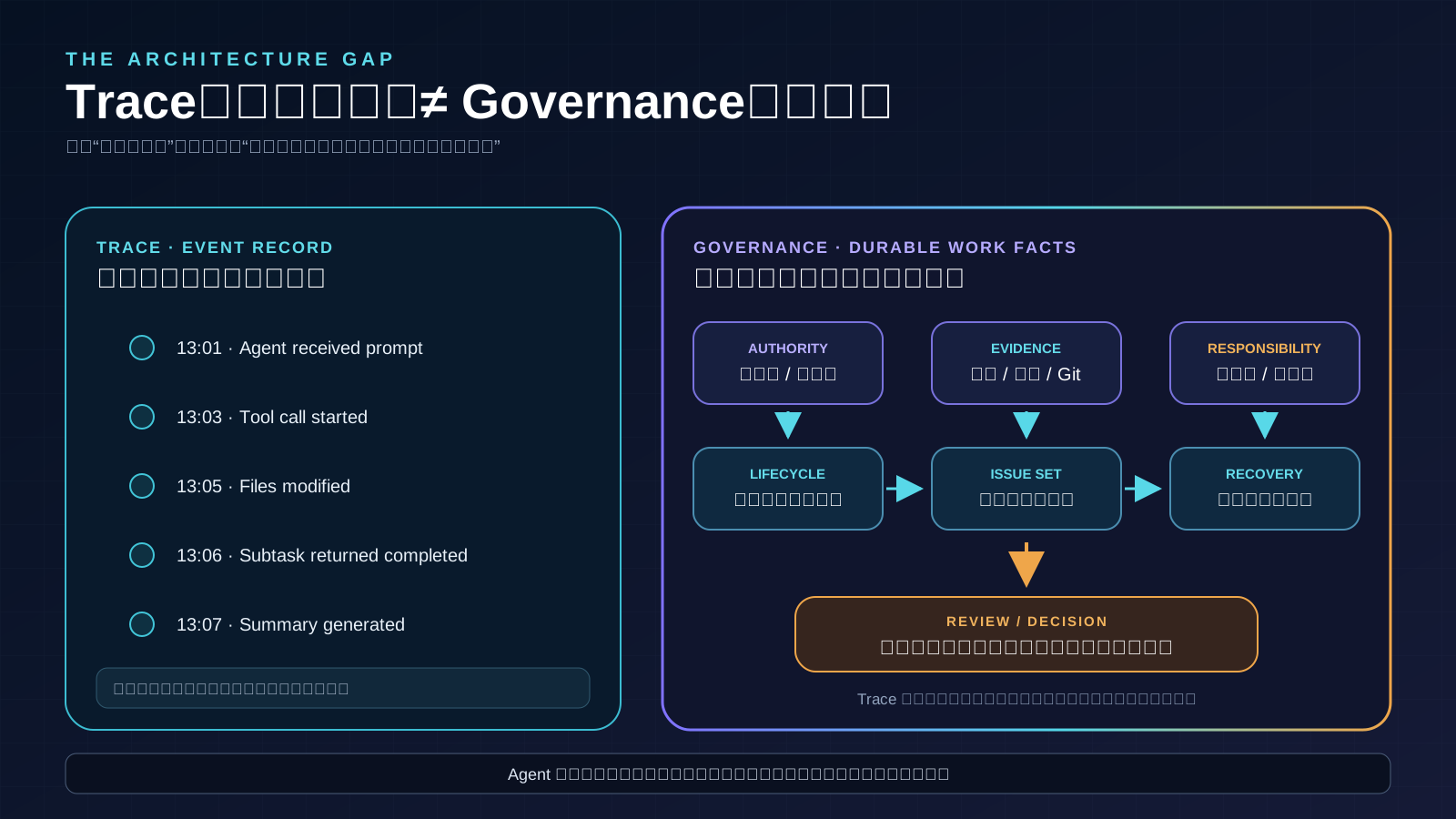
Supplementary view: Trace records execution events that occurred; Governance reconstructs legitimate state from durable work facts, rules, responsibility, and authority.
That is why TMPA exists.
4. TMPA: Work facts must exist independently of the Agent
TMPA asks a simple question: when Agents and humans jointly perform long-running work, where should trustworthy work state live?
This is TMPA's formal answer:
TMPA (Textual Multi-Agent Process Architecture) is an asynchronous text-message multi-agent process architecture designed for SMEs and minimum-infrastructure conditions. Its core consists of four connected rules: text carries durable messages and state; each writer maintains its own local serial stream; multiple serial streams advance asynchronously to form parallel collaboration; the read side aggregates available evidence to reconstruct process, responsibility, lifecycle, conflicts, and audit state.
This section and Sections 5–7 expand these four rules in order: this section covers durable messages and state in text; Section 5 covers local Single-Writer serial streams; Section 6 covers asynchronous parallel collaboration across streams; Section 7 covers read-side reconstruction and the Issue Set.
As of August 11, 2026, TMPA has entered the stable V1.0 release line: Architecture Paper A1.0, Core Specification S1.0, and Implementation Case I1.0 now form the stable three-part publication set; I1.0 pins CodeFlowMu v1.8.0 and records a 14/14 product validation result against S1.0.
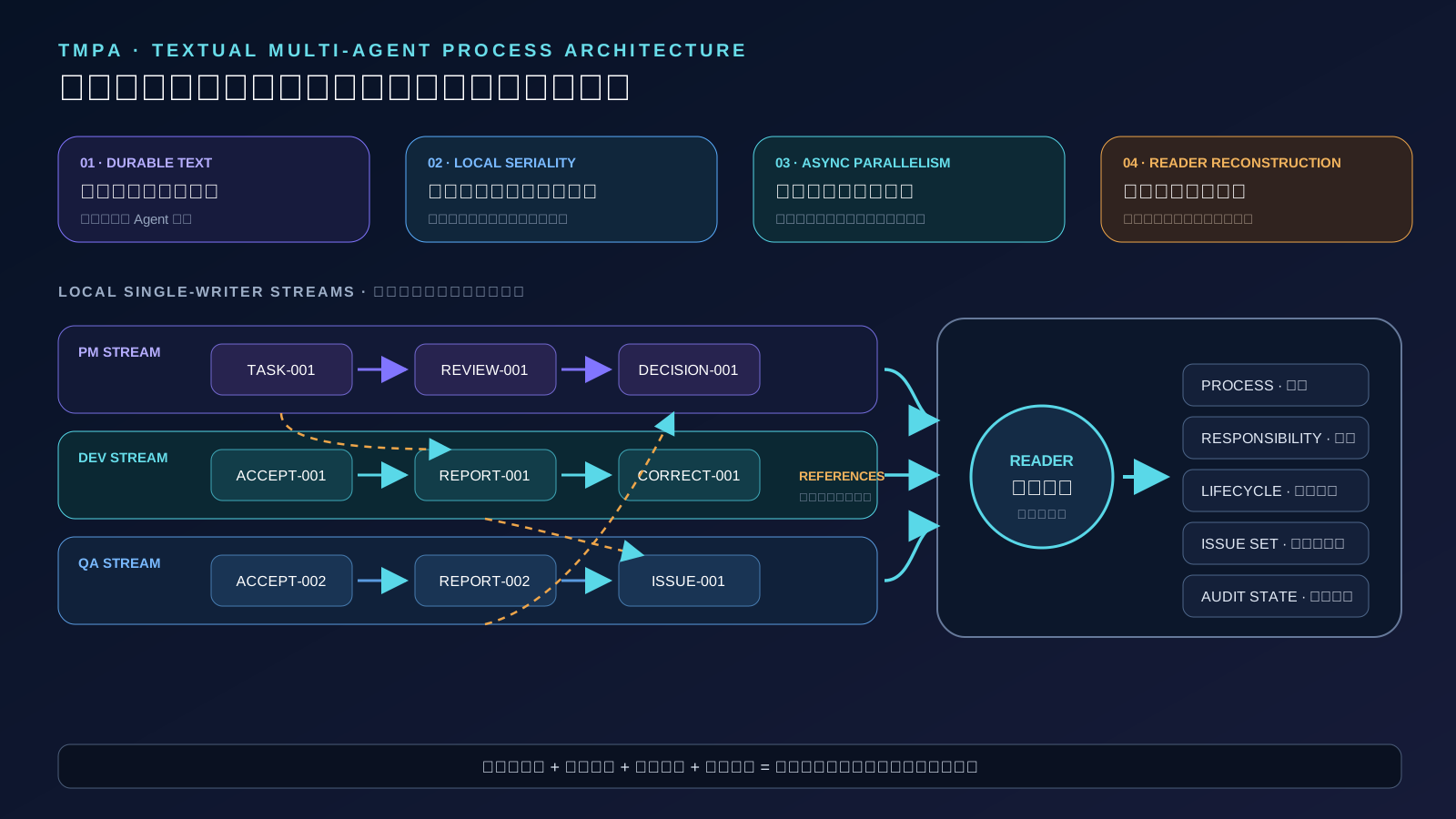
Supplementary view: Each actor appends its own facts, cross-stream references preserve partial order, and the Reader aggregates evidence without hiding conflicts.
“When heterogeneous Agents and humans wrestle with long-running work inside the same codebase, the most absurd choice is to entrust trustworthy state to the volatile memory of a model. TMPA has an iron law: text is fact. The physical topology of files and directories exists only to provide a compliant projection; immutable text objects are the only hard currency that survives across cycles.”
Important work facts are projected into plain, portable text.
These are not merely chat transcripts. They are formal work objects such as Task, Acceptance, Report, Review, Decision, Correction, and Issue.
Those objects form causal relationships through Reference Identifiers.
Agents can exit. Models can change. Processes can restart. Nodes can go offline.
Established work facts remain.
That is the first foundation for a long-running SaaW.
5. Single-Writer: Responsibility needs a clear source
Another core TMPA principle is:
Single-Writer Serial Streams
Each Agent or human responsibility holder is an independent Single Writer.
This means one actor does not silently rewrite facts authored by another actor.
New state is created by appending new objects.
TASK
  │
  ▼
ACCEPTANCE
  │
  ▼
REPORT
  │
  ▼
REVIEW
  │
  ▼
DECISION
“The cancer of enterprise collaboration is the chaos of ‘anyone can change state.’ In TMPA Single-Writer Serial Streams, every actor—human or Agent—is an absolutely isolated Single Writer. You may append only your own facts; you do not get to contaminate someone else’s history. Responsibility is not ‘calculated’ by database transaction locks; it ‘grows’ out of the tamper-proof reference chain of Single-Writer streams.”
This differs in an important way from many traditional workflow engines.
Traditional systems often keep mutating one central state:
status = pending
status = running
status = review
status = done
In the end, all you see is status = done, while the actual process that produced that state has been overwritten.
TMPA is more concerned with: Who accepted the work? Who submitted it? Who reviewed it? Who approved it? What disputes occurred? Which facts were later corrected?
State is not merely overwritten.
It is reconstructed.
6. The asynchronous world has no perfect global timeline
Real multi-agent systems are asynchronous.
PM may write a plan while DEV changes code, QA checks another module, OPS handles deployment, and a human supervisor approves hours later.
Forcing a perfect global sequence can hide the real concurrency.
TMPA therefore emphasizes:
Asynchronous Collaboration
“Trying to fabricate a single global timeline in an asynchronous multi-agent world is architectural arrogance. Writers do nothing but lock-free appends; the Partial-Order Graph is rebuilt dynamically on the read side. Without the blind commands of a central scheduler, multi-agent work grows wild and staggered through local text streams. That is the brutal truth of high-concurrency digital labor.”
            ┌── DEV REPORT ──┐
TASK ───────┤                ├── REVIEW
            └── OPS REPORT ──┘
Which report happened first is less important than their causal relationship to the same Task and the Review that depends on them.
This is closer to how real organizations actually work.
7. Issue Set: Do not hide disagreement
Automation systems often prefer a cosmetically green final state.
Real organizations are not like that.
References may be missing. State transitions may be illegal. QA may reject DEV. Reports may lack evidence. Decisions may lack valid preconditions. Roles may disagree.
TMPA does not try to make those problems disappear.
It makes them formal facts.
The key is not merely to list errors, but to perform read-side reconstruction. The write side does not silently resolve conflicts or treat arrival order as governance order. The Reader aggregates the currently available evidence to reconstruct process, responsibility, lifecycle, conflicts, and audit state; the Issue Set is the formal representation of conflicts, gaps, and illegal states within that reconstruction.
TMPA does not promise that conflicts never occur; it requires that conflicts cannot be hidden.
The Reader therefore reconstructs not only a Process Graph but also an Issue Set, such as:
dangling_reference
illegal_transition
unresolved_disagreement
missing_acceptance
conflicting_review
This is an important SaaW capability.
Enterprises do not need mythical AI that never fails.
They need AI systems that can tell where failure occurred and surface it to the right authority.
8. Recoverability: A digital employee must be able to wake up and continue
The difference between SaaW and a chatbot is partly a difference in time scale.
A chatbot session may last minutes. Real work can last hours, days, weeks, or months.
Digital employees will encounter network interruptions, SDK timeouts, Agent exits, runtime restarts, context loss, operating-system restarts, and software upgrades.
If every failure requires telling the AI the whole story again, it cannot become a reliable Worker.
SaaW therefore needs:
Recoverability
TMPA allows governance state to be recalculated from persistent work facts.
CodeFlowMu / FCoP projects that idea into the file system.
After restart, the runtime rereads TASK, ACCEPTANCE, REPORT, REVIEW, DECISION, and ISSUE, then derives current responsibility, completed work, approved results, unresolved problems, legal next actions, and the next actor.
Recovery is not about restoring an Agent's memory.
It is about reconstructing the facts of work.
A Day in the Life of a Digital Researcher: Research Report Production Engine V1.3
There is no need to invent a fictional job. The Research Report Production Engine V1.3 already gives us a real, observable example of a digital researcher at work.
09:00 · Research Discovery
The digital researcher starts the day by scanning new research signals, engineering changes, and open questions, deciding what deserves attention.
Output: Signal Pool.
10:00 · Research Queue
It selects the research object that should actually move forward that day, sets priority, and decides what the day's research will focus on. It does not turn every signal into an article.
Output: Today's Research Plan.
11:00 · Research Reading
It reads papers, specifications, engineering records, code, test results, and existing material around the selected object, organizes usable evidence, and records what is still missing.
Output: Reading Result.
13:00 · Research Analysis
It turns the morning's material into judgments: which facts hold, which statements remain inference, where disagreement exists, what the boundary conditions are, and what research conclusion should be formed next.
Output: Research Object.
15:00 · Research Production
The digital researcher turns the research object into a formal work product: structuring the article, drafting the report, checking evidence, and adding required diagrams or visualizations until a publishable candidate exists.
Output: Publication Candidate.
20:00 · Formal Publication
Once the candidate satisfies publication conditions, it enters the formal release path: committing to GitHub, generating the website, verifying the commit, and confirming the release. If an action requires accountable human authority, the work stops at that authority boundary and waits for a human decision.
Output: Formally Published Research Result.
09:00 Research Discovery   → Signal Pool
10:00 Research Queue       → Today's Research Plan
11:00 Research Reading     → Reading Result
13:00 Research Analysis    → Research Object
15:00 Research Production  → Publication Candidate
20:00 Formal Publication   → GitHub + Website + Commit Verify + Release
That is a day in the life of a digital researcher: it is not answering one question; it is continuously performing a research job under a defined role and work rhythm.
9. FCoP: File-based Coordination Protocol
FCoP (File-based Coordination Protocol) is a multi-agent behavioral-governance protocol that uses the filesystem as its only synchronization primitive.
Its core invariant is Filename as Protocol. In its project-visible filesystem profile:
- directory is state:
_lifecycle/{inbox,active,review,done,archive}/; - filename is routing: sender, recipient, type, and sequence identify origin, destination, and work-object identity;
- content is payload: Markdown plus YAML frontmatter carries tasks, reports, issues, references, and governance facts;
os.rename()is the only synchronization operation: lifecycle transitions rely on atomic filesystem moves rather than a coordination database, message broker, or central lock service.
A task lifecycle is therefore directly observable:
inbox      waiting to be claimed
  │
  ▼
active     in execution
  │
  ▼
review     awaiting review
  │
  ▼
done       completed
  │
  ▼
archive    archived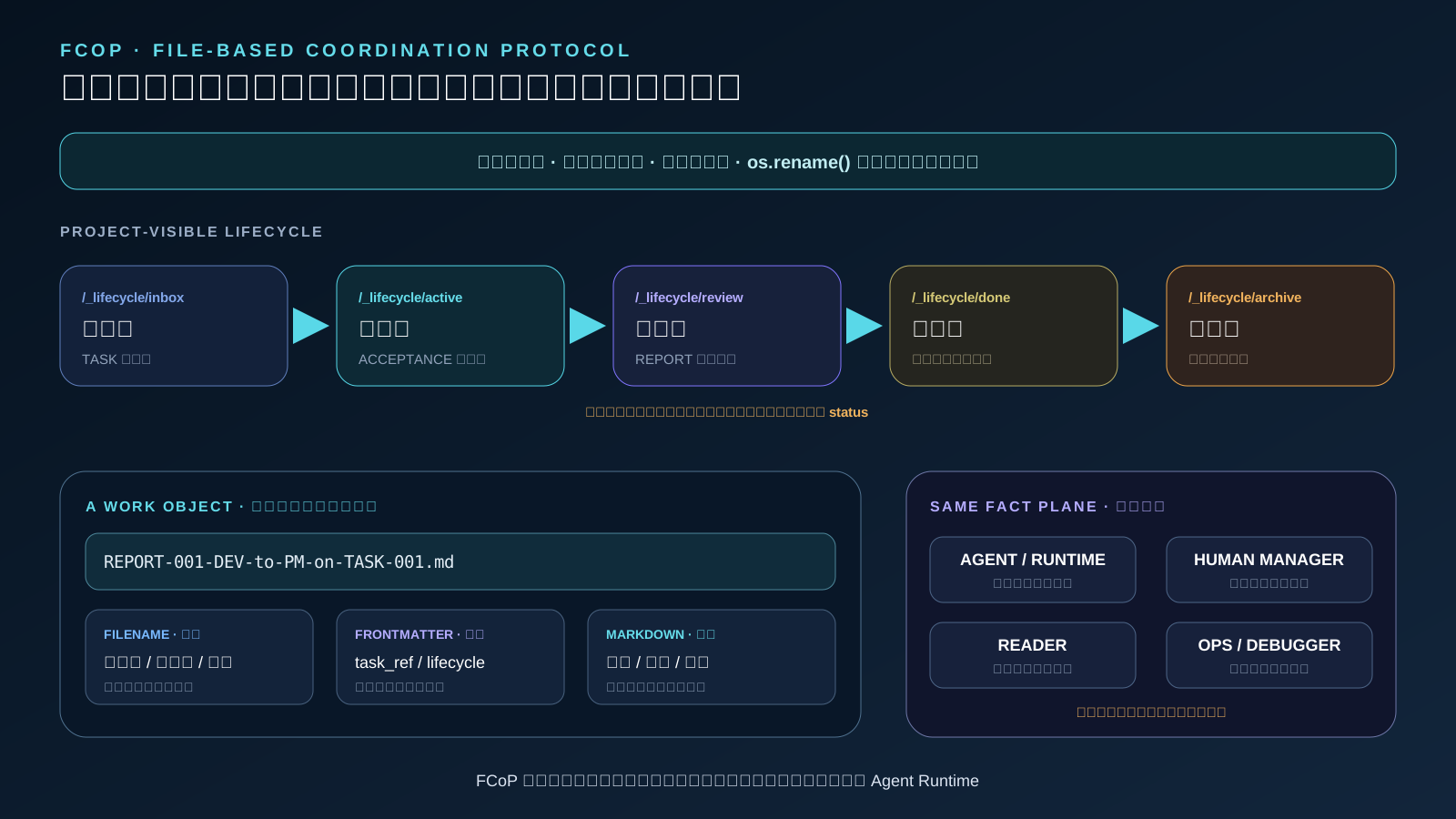
Supplementary view: Lifecycle changes are expressed through project-visible work objects; humans, Agents, Readers, and operations tools observe the same fact plane.
FCoP governs Agent collaboration behavior: how tasks are handed off, results are reported, issues are raised, capability boundaries are declared, and those behaviors leave event semantics, failure boundaries, and auditable evidence.
FCoP does not govern the execution runtime. Scheduling, process management, model sessions, resource allocation, identity authentication, and runtime-node management are outside the protocol itself.
In the TMPA implementation relationship, FCoP acts as a project-visible filesystem profile. It does not require a coordination database, message broker, or enterprise control plane; conversely, it does not by itself provide validated enterprise identity, strong role isolation, tamper-resistant storage, or Byzantine fault tolerance. This is consistent with TMPA being SME-first, not SME-only: larger deployments can add databases, object stores, event services, identity systems, and control planes without changing the governance semantics carried by the protocol.
Most importantly, the FCoP protocol, packages, host-adapter responsibilities, reference implementation, and runtime environment are not the same thing. With TMPA V1.0 formally released, this operating relationship is now frozen in the stable A1.0 / S1.0 / I1.0 release line. The operational stack can be represented directly as:
Application / Runtime
CodeFlowMu / Cursor / Claude Desktop
                │
                ▼
Host Adapter Layer
fcop-mcp / host bridges
                │
                ▼
★ FCoP Protocol Layer ★
behavior governance / handoff / reporting / review
capability boundaries / event semantics / failure boundaries / audit
                │
                ▼
Reference Implementation
fcop Python library
                │
                ▼
Execution Substrate
LLM APIs / MCP tools / filesystem / process manager / operating system
Therefore:
fcopis a Python package distributed on PyPI and the reference implementation of FCoP; it also provides the CLI capability;fcop-mcpis an FCoP MCP tool package distributed on PyPI; in the operational stack it performs host-adapter responsibilities, exposing FCoP capabilities to actual hosts;- CodeFlowMu is an application/runtime system that uses FCoP as its coordination protocol.
- TMPA is not a runtime layer in this stack; it supplies the higher-level governance semantics and architectural guidance the stack is intended to realize.
This also explains why “directory is state” matters: administrators, human supervisors, Agents, and debugging tools can inspect the same project-visible facts without first entering a hidden central coordination state.
10. CodeFlowMu: From protocol to the real runtime world
If TMPA defines work-fact and governance semantics, and FCoP supplies a project-visible file-based coordination protocol, then CodeFlowMu addresses how those semantics and that protocol enter a real Agent runtime world.
CodeFlowMu did not begin by constructing a giant central Agent Runtime.
Instead, it remains deliberately restrained: reasoning is delegated to mature model ecosystems, tools remain in real operating environments, and CodeFlowMu concentrates on work orchestration, Agent responsibility boundaries, lifecycle, FCoP integration, Skill invocation, Reports, Reviews, human decisions, recovery, and runtime governance.
This creates an important engineering boundary:
CodeFlowMu does not need to reinvent the LLM, and it does not redefine FCoP.
The model is only one part of a digital employee's brain; FCoP is the coordination protocol it uses; what determines whether the digital employee can sustain responsibility is the surrounding work structure, runtime environment, and governance loop.
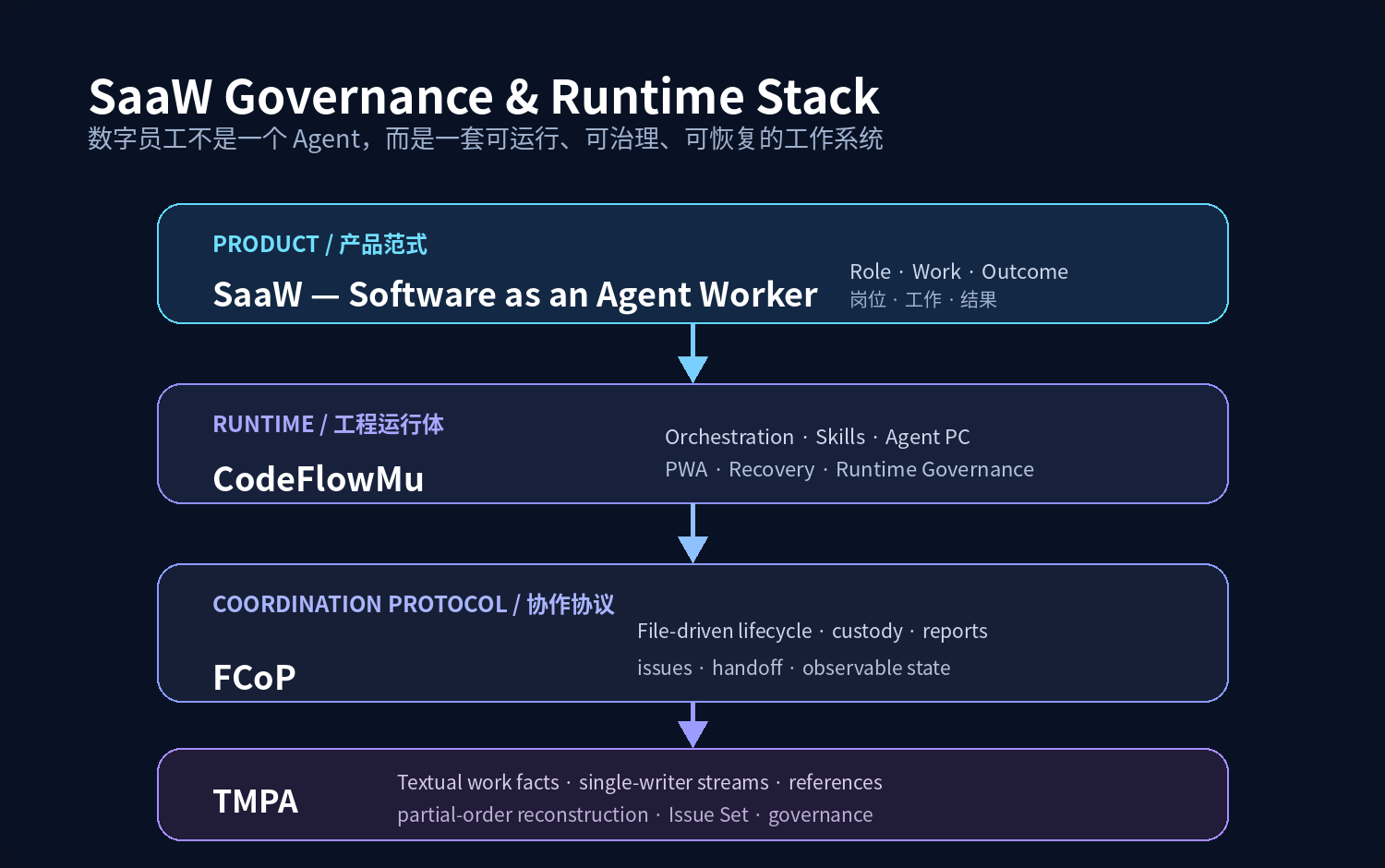
Figure 1. TMPA supplies work-fact and governance architecture; FCoP supplies the file-based coordination protocol; CodeFlowMu provides the engineering runtime; SaaW names the resulting software-delivery paradigm.
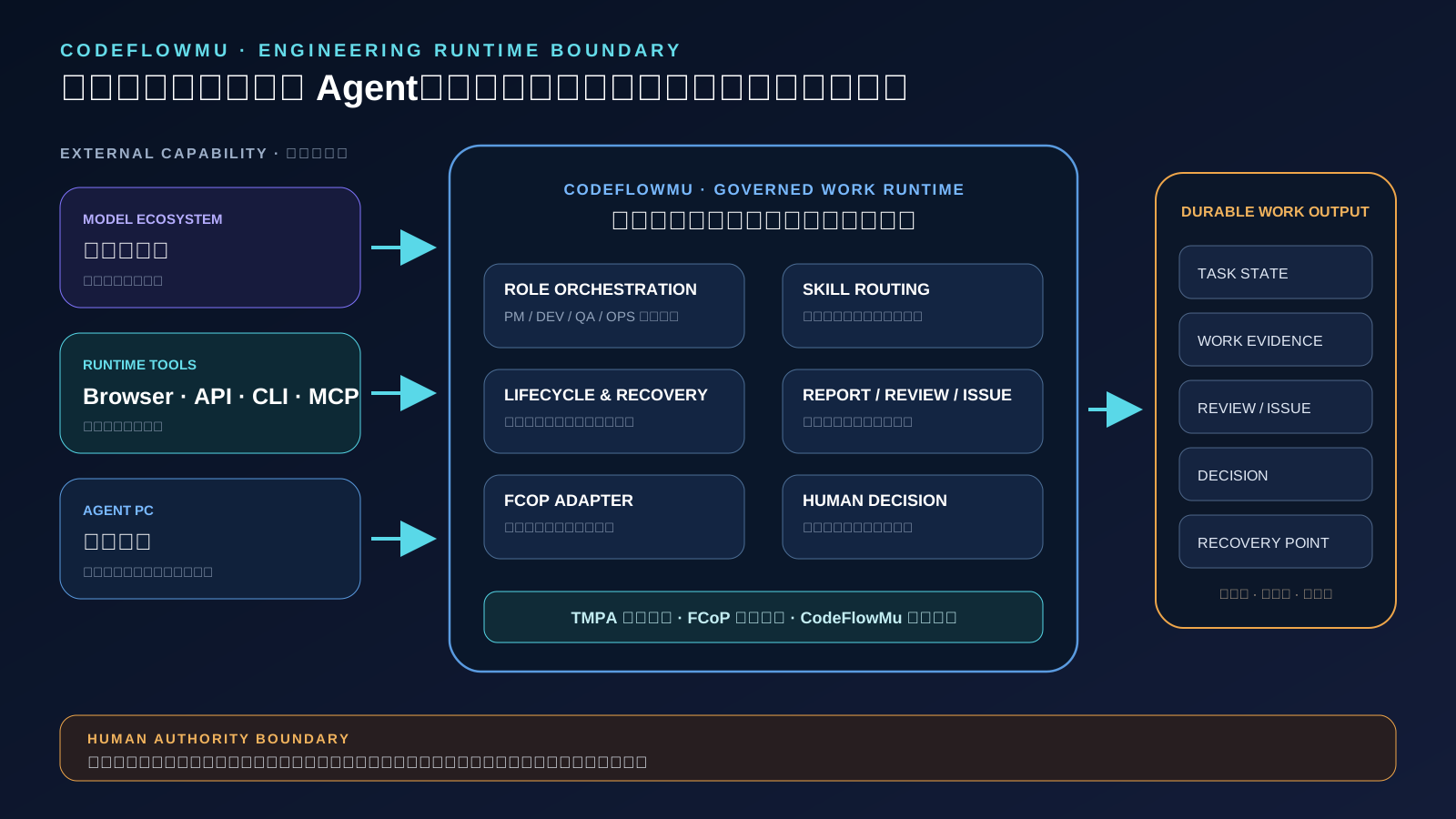
Supplementary view: Models reason and tools act. CodeFlowMu organizes work, FCoP carries facts, and TMPA guides governance semantics.
11. Agent PC: A real digital employee needs a “computer”
If SaaW is a Worker, the Worker needs a work environment.
We call this runtime node:
Agent PC
It does not have to be a physical computer. It represents an independent runtime environment containing Reasoning, Skills, Workflow, Credentials, Runtime, Files, Governance, and External Systems.
It may use browsers, APIs, CLI tools, scripts, MCP, internal enterprise services, and controlled automation hooks.
The loop therefore changes from Prompt → Response into:
Task
 ↓
Reason
 ↓
Use Skill
 ↓
Operate Business System
 ↓
Observe Result
 ↓
Produce Evidence
 ↓
Continue / Report / Escalate
That is a digital-worker runtime loop.
12. Non-invasive digital employees: Let AI use software, not bypass software
One of the most dangerous temptations in enterprise automation is to let AI modify the database directly.
That may look extremely efficient.
But real enterprise systems are not simple CRUD layers.
A single field may sit behind state machines, triggers, stored procedures, permission rules, financial constraints, workflows, audit trails, and external-system integrations.
Writing directly to tables can bypass decades of accumulated business boundaries.
SaaW should therefore prefer a different path:
AI operates the business system rather than bypassing the business system.
Agent
  │
  ├── API
  ├── Browser
  ├── CLI
  ├── Controlled Hook
  └── Approved Automation
        │
        ▼
Existing ERP / CRM / Business System
The point is not to guarantee that AI will never make mistakes. It is to keep mistakes, as far as possible, inside boundaries where existing business rules can observe, reject, audit, and roll them back.
That is the engineering posture enterprise AI automation actually requires.
13. Rediscovering enterprise SOP from code
Legacy software contains an often underestimated asset:
Code itself is enterprise knowledge.
Many enterprise processes do not have complete SOP documentation.
The real rules are often hidden in APIs, controllers, forms, validation logic, state transitions, permission checks, batch scripts, database schemas, and configuration.
An important direction for CodeFlowMu is therefore to let a Meta-Development Team analyze existing systems and help reconstruct:
Existing Code
      │
      ▼
Business Rules
      │
      ▼
Workflow
      │
      ▼
SOP
      │
      ▼
Digital Employee Skills
But this does not mean that “scanning code = automatically understanding the entire enterprise.”
Real SOP may also come from documents, human explanations, API specifications, operation recordings, job descriptions, policy rules, and domain-expert feedback.
Code is only one extremely important source of facts among them.
A more rigorous formulation is:
Enterprise Evidence → Candidate SOP → Validation → Governed Workflow
AI makes it possible to restructure these scattered forms of knowledge at much lower cost; but a Candidate SOP should become an executable digital-employee workflow only after business validation, engineering testing, governance checks, or human authorization.
14. CodeFlowMu's second form: Meta-Development Runtime
The most important thing about CodeFlowMu is not merely that multiple Agents can develop software together.
More importantly, that development capability can itself become production capability for the next generation of digital employees.
We call this form the Meta-Development Runtime.
An initial CodeFlowMu instance can appear as a four-role development team:
┌───────────────────────────────┐
│      CodeFlowMu Meta Team     │
│                               │
│ PM        DEV       QA    OPS │
└───────────────────────────────┘
Each role has its own responsibility boundary.
PM interprets requirements, decomposes work, and organizes collaboration.
DEV implements code, Skills, Hooks, and workflows.
QA verifies business outcomes and engineering outcomes.
OPS manages the runtime environment, recovery, deployment, and lifecycle.
This is CodeFlowMu's Meta-Development Mode.
Its output does not have to be only traditional software. It can also be:
a Digital Employee Package.
15. Digital Employee Package: Turning Digital Employees into Engineered Products
Before a digital employee can truly be deployed, it needs an engineering description.
A complete Digital Employee Package typically includes at least:
- role;
- job responsibilities;
- workflow;
- Skills;
- permissions;
- governance policies;
- validation rules;
- runtime configuration;
- recovery rules;
- human decision gates.
For the first time, a digital employee begins to look like a real software product: it can be defined, developed, tested, versioned, deployed, upgraded, and rolled back.
That is one of the fundamental differences between SaaW and “writing an Agent prompt.”
A Real Engineering Anchor: The SaaW Manifesto Is Part of the Case
There is an important recursive relationship here.
We are not first writing a manifesto that claims SaaW exists and then searching for a fictional example to prove it. We use the operating Research Report Production Engine V1.3 to explain SaaW, while this SaaW Manifesto itself becomes a research artifact managed, reviewed, and published through that production system.
The research-production chain can be written as:
Research Question
        ↓
Research Object
        ↓
Evidence / Reading
        ↓
Analysis
        ↓
Report
        ↓
Evidence Gate
        ↓
Visualization
        ↓
Human Authorization
        ↓
Publication
Expressed in SaaW worker terms, the same chain becomes:
Role → Workflow → Skills → Work State → Evidence
     → Governance → Human Authority → Work Outcome
These are not two different systems. They are two descriptions of the same fact: software begins to take on continuous work under explicit responsibilities, evidence rules, and authority boundaries.
This is not an AI writing tool. It is a governed research worker.
16. Self-Morphing: When the codebase begins to “develop itself”
Now we reach the central idea of this manifesto:
Self-Morphing
It does not mean that an Agent freely mutates its source code, and it does not mean unrestricted AI self-replication.
Self-Morphing means that a digital-employee runtime can use its own software-development capability to construct, validate, and deploy new digital-worker forms.
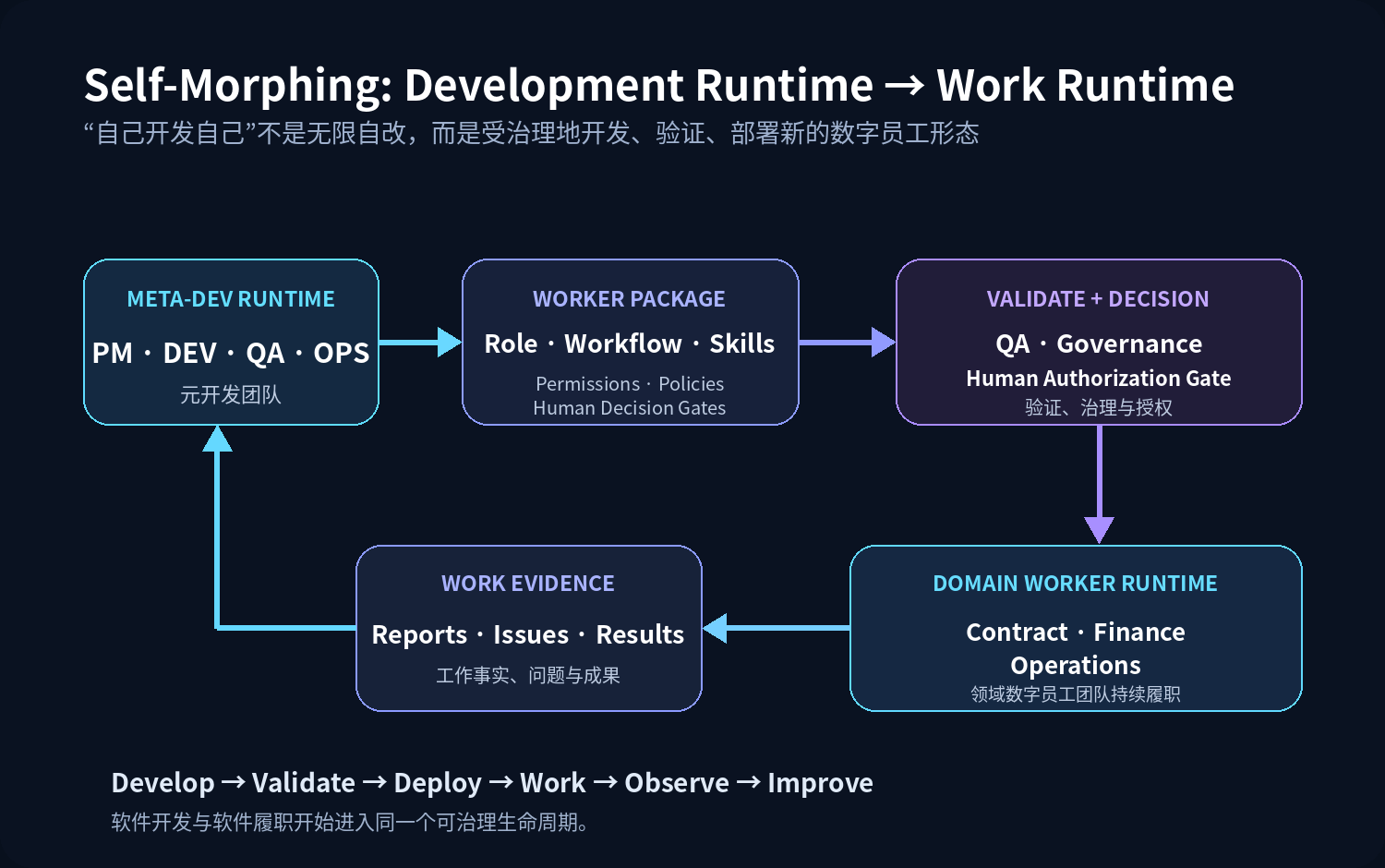
Figure 2. The governed Self-Morphing loop brings development, validation, authorization, deployment, work execution, and work evidence into one recoverable and traceable lifecycle.
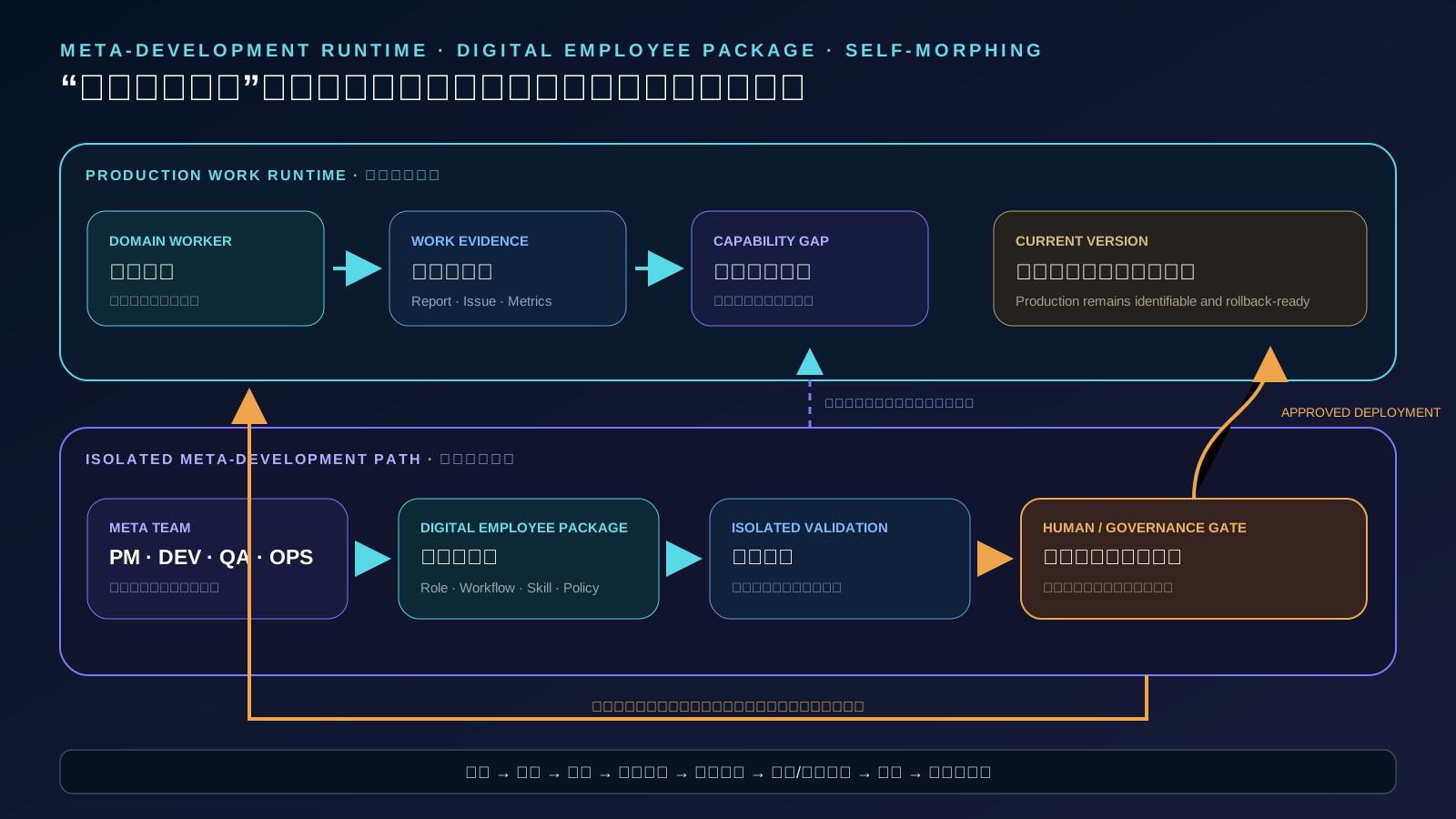
Supplementary view: Production evidence can enter meta-development, but meta-development cannot rewrite the live production runtime; validation and authorization control deployment, with rollback preserved.
Meta-Dev Runtime
        │
        ▼
Analyze Existing Work
        │
        ▼
Develop Worker Package
        │
        ▼
Validate
        │
        ▼
Human / Governance Decision
        │
        ▼
Deploy
        │
        ▼
Domain Worker Runtime
For example:
PM / DEV / QA / OPS
        │
        │ develops
        ▼
Finance Worker Package
        │
        ▼
Invoice Agent
ERP Entry Agent
Compliance Agent
Archive Agent
Or:
PM / DEV / QA / OPS
        │
        ▼
Contract Worker Package
        │
        ▼
Risk Analysis Agent
Signing Agent
Compliance Agent
Archive Agent
Traditional software development looks like:
Human
  ↓
builds Software
  ↓
Human uses Software
Self-Morphing introduces another pattern:
AI Development Team
        ↓
builds Digital Worker
        ↓
Digital Worker performs Work
And the next step is even more important:
Worker performs Work
        │
        ▼
Evidence / Issues
        │
        ▼
Development Input
        │
        ▼
Next Worker Version
Development and work begin to form one loop:
Develop → Validate → Deploy → Work → Observe → Improve
That is the meaningful engineering interpretation of “the codebase develops itself.”
17. From Development Runtime to Work Runtime
Traditional software separates development, production runtime, and human work.
SaaW begins to recombine them.
CodeFlowMu's long-term direction can be expressed as follows:
Development Runtime
        │
        ▼
Digital Employee Package
        │
        ▼
Work Runtime
        │
        ▼
Work Evidence
        │
        ▼
Development Runtime
This is not merely DevOps.
DevOps connects Development and Deployment.
SaaW attempts to connect:
Development and Work.
That may become one of the deepest boundaries between AI-native and traditional software.
18. Humans do not disappear; they leave the operation layer
The appearance of digital employees does not mean removing humans from the work loop.
On the contrary.
A safe SaaW must clearly define which actions an Agent can complete autonomously within its authority, and which actions must be decided by a human.
In SaaS, humans usually remain in the software operation layer; in SaaW, humans increasingly move into supervision and final authorization.
Low-risk work such as querying, organizing, validation, report generation, and internal synchronization can become highly automated.
Large payments, final contract signatures, permission escalation, irreversible data operations, and important public publication should enter explicit human decision gates.
More precisely:
Human at the Authority Boundary.
19. PWA: The mobile control plane for a digital-employee team
The CodeFlowMu PWA is therefore not merely a mobile webpage.
It represents the digital-employee team's Human Control Plane.
A manager can use a mobile device to inspect current tasks, Agent state, Reports, Reviews, Issues, pending decisions, recovery state, and work outcomes.
SaaW Runtime
      │
      ▼
Report
      │
      ▼
FCoP / TMPA Work Facts
      │
      ▼
Reader
      │
      ▼
Mobile PWA
      │
      ▼
Human Approves / Rejects
      │
      ▼
Formal Decision
      │
      ▼
SaaW Runtime continues
The most important point is that approval is not merely a UI click.
The click is only the interface.
What actually happens is:
Human Decision
        ↓
Governance Fact
        ↓
State Transition
Authorization therefore becomes part of the formal work history.
That is Human-in-the-Loop Governance in the real sense.
20. A digital employee must not depend on a model session that never disconnects
Many Agent products today hide a dangerous assumption: that the model session will always remain alive.
The real world does not work that way.
Models time out. Context windows overflow. Gateways fail. Agents crash. Software upgrades. Servers restart.
A real SaaW must therefore follow one critical principle:
Agents are replaceable. Work facts are not.
Agents can change. Models can change. SDKs can change. Runtimes can restart.
But already established work facts must not disappear with them.
This is where TMPA, FCoP, and CodeFlowMu ultimately converge:
Decouple intelligence from session continuity, and build work continuity on durable facts.
This may be one of the most important architectural principles for building long-running digital employees.
21. SaaW changes software economics, not merely AI
Ultimately, SaaW is not merely another Agent Framework.
It may imply a change in the economic model of software.
The SaaS business logic is: enterprises buy software capability and then continue staffing people to perform the work.
The SaaW business logic may become: enterprises deploy digital work capacity, and work outcomes become part of software delivery for the first time.
Therefore:
SaaS sells capability.
SaaW delivers work.
Enterprises may eventually buy not only CRM, but a digital customer-operations team; not only finance software, but digital finance workers; not only a contract-management platform, but a digital contract-review and fulfillment team.
The software market may gradually expand from a software market into a:
Digital Labor Market
That is the much larger space of possibility opened by SaaW.
22. SaaW is not a new chat box
The whole argument can be reduced to one sentence:
A digital employee is not a smarter chatbot.
It requires job responsibilities, a work environment, tools, permissions, state, governance, evidence, recovery capability, and human authority boundaries.
TMPA studies how those work facts become valid.
FCoP studies how coordination can be projected in an extremely lightweight way.
CodeFlowMu studies how Agents actually form teams and continue working.
Agent PC provides the work environment.
PWA provides the human control surface.
SaaW gives the whole transition a higher-level name:
Software as an Agent Worker
23. From SaaS to SaaW
For the past forty years, software has largely answered one question:
How can we help humans work more efficiently?
AI-native software is beginning to face another:
Which work can software itself perform?
This does not mean software will replace everyone.
The deeper change may be that humans gradually leave repetitive software operation, Agents enter the operation layer, and humans move into the governance layer.
So:
SaaS
Human operates Software
        ↓
Copilot
Human operates with AI
        ↓
SaaW
AI performs Work
Human governs and authorizes AI
And when a system capable of developing digital workers begins to use that capability to develop the next generation of digital workers:
AI develops Digital Worker
        ↓
Digital Worker performs Work
        ↓
Work produces Evidence
        ↓
Evidence drives the next Development cycle
        ↓
AI develops the next Digital Worker
A software lifecycle that did not previously exist begins to form.
Validated (Today)
To avoid packaging research directions as already completed product capability, the engineering facts that exist today should be stated separately:
- FCoP's file-driven lifecycle, task handoff, Reports, and Issues;
- real PM / DEV / QA / OPS four-role Agent collaboration loops;
Report,Review,Decision, and human approval paths;- the PWA human control plane and pending-decision handling;
- recovery governance after runtime interruption;
- TMPA Reader, specification tests, and reconstruction of work facts;
- real CodeFlowMu engineering cases;
- the Research Report Production Engine V1.3 production chain from research task to governed publication.
Under Exploration (Next)
Still under research, standardization, or broader engineering validation are:
- standardized Digital Employee Packages;
- standardized Agent PC;
- role-specific Work Runtimes;
- Candidate SOP extraction from legacy systems and enterprise evidence;
- Meta-Development Runtime → Domain Worker Runtime transformation;
- governed Self-Morphing.
This distinction is not conservatism; it is part of credibility: validated capability should be stated with evidence, while frontier capability should remain a research proposition. Self-Morphing is more credible precisely because it is built on governance, recovery, work facts, and engineering runtime capabilities that already exist.
That is the direction CodeFlowMu is exploring.
Not another Multi-Agent Framework.
Instead:
Software infrastructure capable of developing, running, governing, recovering, and continuously evolving digital employees.
That is the real reason we propose SaaW.
SaaW — Software as an Agent Worker
Software was once a tool.
Then it became a service.
Now, it is beginning to work.
From Software Market to Digital Labor Market.
Author / Publisher: joinwell52 Research Center / CodeFlowMu Core Team
Architecture and Theory: TMPA Architecture Paper — A1.0
Normative Standard: TMPA Core Specification — S1.0
Implementation Case (author-run engineering evidence): TMPA–FCoP–CodeFlowMu Implementation Case — I1.0 (CodeFlowMu v1.8.0 · S1.0 C01–C14 14/14 PASS)
Formal Publication: TMPA V1.0 Publication System, 2026-08-11
Release Record: TMPA V1.0 Formal Release Record
Core Engineering Vehicle: CodeFlowMu / FCoP
V1.1 scope note: This is a technical manifesto for AI-native software, multi-agent engineering, and enterprise digital employees. SaaW, Self-Morphing, and Digital Employee Runtime combine current architecture and engineering practice with active research directions. Capability boundaries are defined by the corresponding public specifications, tests, and implementation evidence.