
Multi-Agent Recovery Needs an Authority Plane, Not Blind Retry
When a multi-agent workflow fails, “retry” and “repair” are not the same operation. Retry can restore liveness after a transient tool fault. It cannot repair semantic corruption if every new attempt consumes the same corrupted state.
Summary
The central judgment is that semantic recovery requires an authority plane: an independently represented lineage that tells workers which state is accepted, stale, quarantined or superseded. A reasoning agent may diagnose or propose a correction, but it should not be responsible for inventing both truth and repair policy from the same potentially corrupted context.
The completed Reading Result uses OrchestraBench as controlled evidence. Its strongest LLM containment result explicitly supplies trusted upstream state, and an ablation removing that signal collapses latent recovery close to baseline. The reusable lesson is therefore trusted-state reconciliation, not autonomous LLM self-healing.
Source
Production consumes the same-day Research Object Q-20260810-02 and uses its completed Reading Result only for citation and evidence verification. The primary source is the OrchestraBench preprint.
- arXiv abstract: https://arxiv.org/abs/2608.05263
- Full text: https://arxiv.org/html/2608.05263v1
Observation
The paper separates transient tool faults from latent semantic/context faults. On its controlled staged computations, blind retry can recover the retryable tool-failure mode, while latent modes continue to propagate because the underlying state remains corrupted.
The depth experiment reports increasing cascade radius as latent faults pass through longer pipelines. More importantly, the policy-conditioned LLM receives a trusted upstream value and explicit permission to repair an anomaly. Removing that trusted-upstream signal materially reduces latent recovery. The authors themselves caution that this row is a trusted-state self-correction probe, not a deployment estimate for autonomous routing.
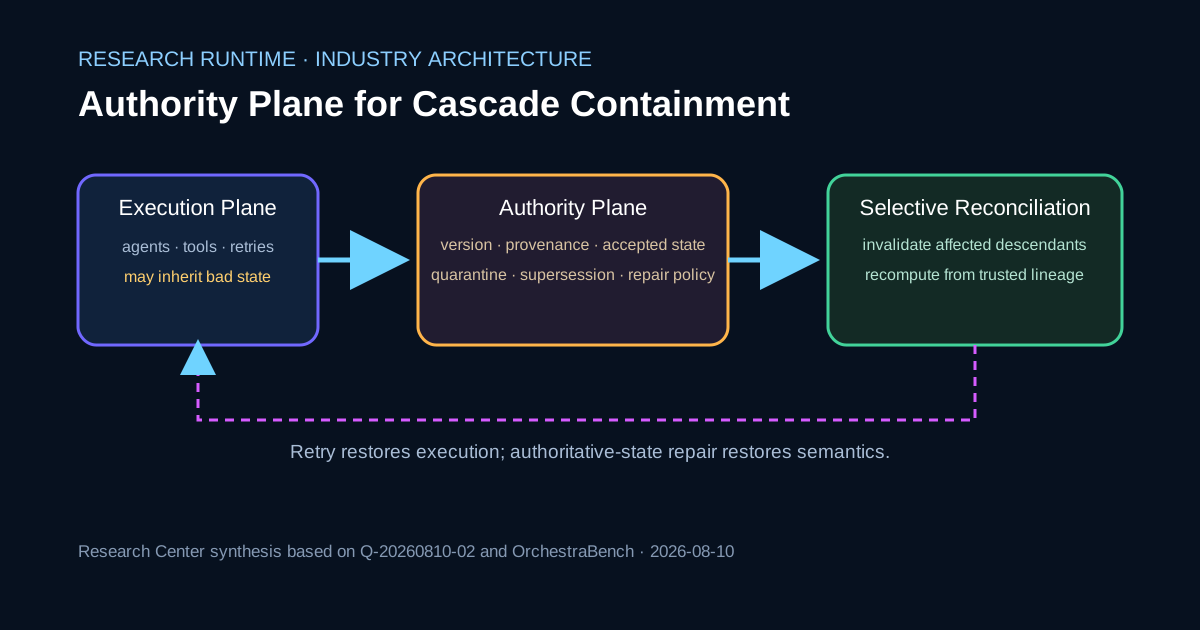
Figure 1. Trusted State and an independent Authority Plane jointly prevent a potentially bad state from cascading downstream. Source: Research Center synthesis based on the cited primary sources.
Comparison
| Recovery mechanism | What it changes | Works best for | Semantic corruption risk | Evidence status |
|---|---|---|---|---|
| Blind retry | Repeats execution with essentially the same state | Transient/retryable tool faults | High when the bad state remains authoritative | Reported baseline mechanism in OrchestraBench |
| LLM repair without trusted upstream | Adds model reasoning but no independent truth signal | Diagnosis may improve in some cases | Model must infer truth from possibly corrupted context | Ablation drops latent recovery near baseline in the tested construct |
| Trusted-state repair | Adds an external correctness/reference signal | Latent/context repair in the controlled probe | Lower when the authority signal is valid | Stronger measured recovery in the paper's probe |
| Authority-plane reconciliation | Research Center architecture proposal: versioned provenance, accepted state, invalidation and selective recomputation | Long-lived production workflows | Depends on authority quality and conflict governance | Architectural inference, not measured by the paper |
The first three rows summarize the paper and completed Reading Result. The fourth is a Research Center architecture synthesis.
Discussion
Reliable orchestration should separate the reasoning plane from the authority plane. Agents can interpret, compare, plan and repair, but authoritative state should be represented independently through a versioned checkpoint, validated business fact, approved human decision, immutable event-log position or another source with explicit provenance.
This also changes how retry policies should be designed. A transport retry asks, “can the same operation succeed if attempted again?” A semantic repair asks, “which state is wrong, which state is authoritative, and which descendants must be invalidated?” Mixing those questions causes systems to repeatedly recompute from corrupted context.
In a branching workflow, cascade impact should not be measured only as linear distance. Production systems need provenance edges that identify which downstream outputs consumed which upstream state version, so recovery can invalidate only affected descendants rather than replaying the whole graph.
Engineering impact
For Digital Employees, preserve authoritative checkpoints for long-running jobs, especially human approvals and externally verified business facts. When inconsistency is detected, reconcile to a trusted state before rerunning downstream work.
For CodeFlowMu, add explicit state-version and provenance fields to workflow nodes. Downstream outputs should declare the upstream version they consumed. Separate transient retry policies from semantic repair policies, and record invalidated descendants so repair scope is observable.
For TMPA, the controlled benchmark is useful evidence for custody, provenance and reconciliation research, but it does not justify treating one benchmark's trusted-state probe as a protocol mandate.
Boundaries and uncertainty
OrchestraBench's core experiments are controlled mechanism probes, not measurements of full enterprise deployments. Some validation reframes the same staged computation in domain language rather than running a real business process. The strongest containment condition has an information advantage because trusted state is supplied explicitly. In production, that authority signal can itself be stale, conflicting or compromised and therefore needs governance of its own.
Future work
The next engineering questions are: what qualifies as authoritative state for each Digital Employee job type; how competing authoritative checkpoints are reconciled; how provenance works across branching DAGs and asynchronous work; and how to measure the cost of attribution plus repair against rollback or human escalation.
Visualization note
The header cover uses a controlled barrier to represent containment of corrupted state by an authority plane. The mechanism figure embedded in the Observation section explains the relationship among trusted state, the authority plane and downstream cascade propagation. The two visual roles use different assets; no vendor artwork or invented quantitative data is used.
References
- OrchestraBench, arXiv preprint
2608.05263: https://arxiv.org/abs/2608.05263 - OrchestraBench full text: https://arxiv.org/html/2608.05263v1
- Research Center Research Object:
research/analysis/Q-20260810-02-authoritative-state-containment.md - Research Center Reading Result:
research/reading/Q-20260810-02-trusted-state-cascade-containment.md
Editing status: published. Trusted-state assumption, ablation interpretation, retry/repair distinction, limitations and bilingual evidence boundary checked.