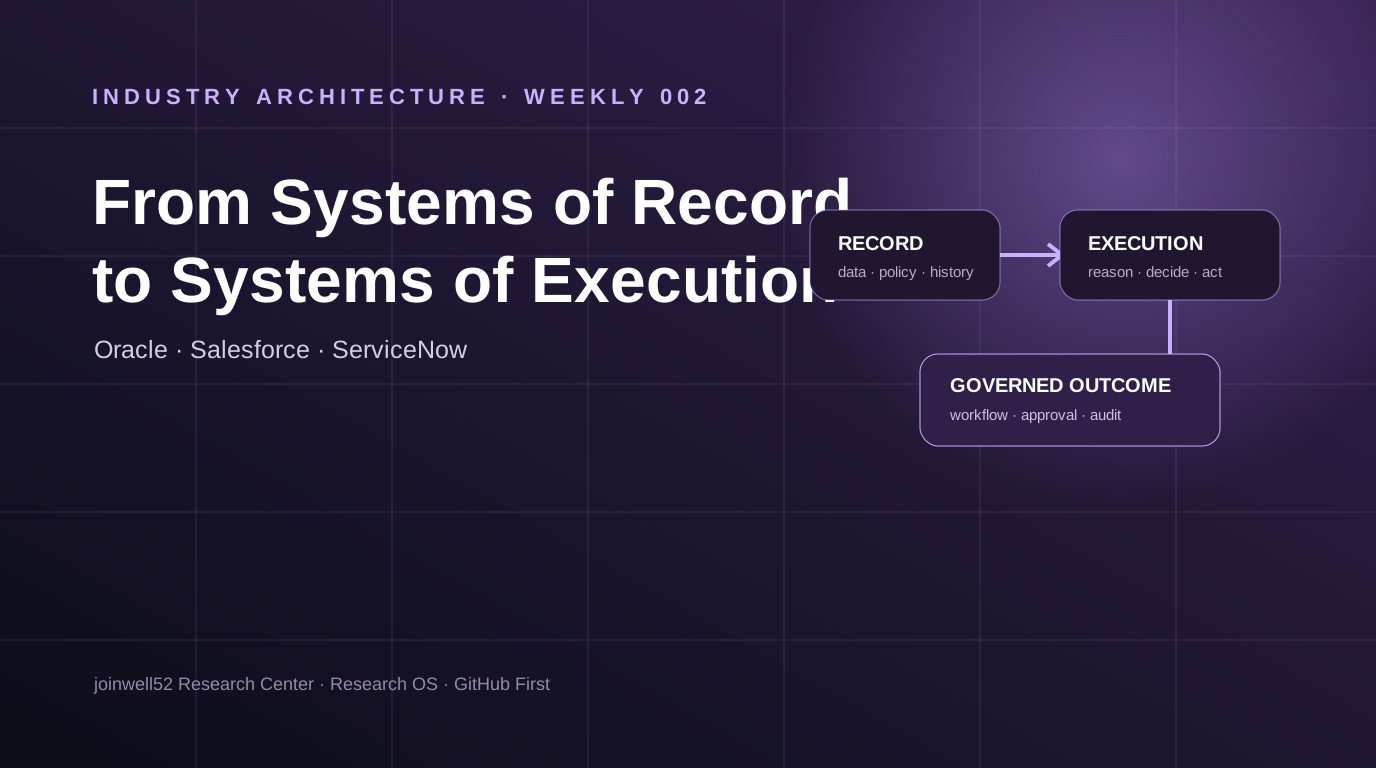
Summary
Traditional enterprise software primarily records customers, employees, finance, assets, process state, and transaction history. Agentic enterprise software is adding a second responsibility: actively executing work inside the same data, authority, and workflow environment.
Oracle defines Fusion Agentic Applications as outcome-driven applications backed by specialized Agent teams using Fusion business objects, workflows, policies, approvals, and logged actions. Salesforce Agentforce combines enterprise data, metadata, skills, flows, and Agent execution into a digital labor platform. ServiceNow Autonomous Workforce uses role-defined AI Specialists with scope, authority, policy, traceability, and human escalation to execute enterprise work end to end.
This report’s judgment is:
Enterprise software will not simply be replaced by a generic Agent layer outside the business system. A more likely architecture combines the System of Record with a governed System of Execution inside the same transactional context.
Source
Three groups of official materials were selected:
- Oracle Fusion Agentic Applications / AI Agent Studio: native Agent teams inheriting Fusion business objects, permissions, workflows, approvals, and audit.
- Salesforce Agentforce: Agents acting through Data 360, CRM metadata, skills, flows, and business logic.
- ServiceNow Autonomous Workforce: AI Specialists completing end-to-end work under defined roles, authority, policy, traces, and escalation.
Marketing terms such as “first,” “limitless workforce,” or “fully autonomous” are not treated as research conclusions. This report analyzes the disclosed architecture mechanisms.
Weekly Highlights
1. Agents are moving inside transactional systems
Oracle explicitly contrasts Fusion Agentic Applications with disconnected external Agent layers. They operate directly on Fusion business objects, workflows, tools, policies, and approvals while inheriting security and audit controls.
Salesforce similarly grounds Agentforce in enterprise data, metadata, flows, and existing application logic. ServiceNow connects AI Specialists to workflows and systems of record.
The direction is moving from “an Agent calls several APIs” toward “an Agent becomes a governed execution subject inside the business system.”
2. The product unit is shifting from Agent to Agentic Application or Workforce
Oracle’s newer unit is not a standalone Agent, but an Agentic Application composed of specialized Agent teams, user experiences, workflows, tools, policy, approval, and runtime assets.
ServiceNow uses Autonomous Workforce and AI Specialist. Salesforce uses Digital Labor Platform. The common shift is that vendors increasingly sell systems that complete business outcomes rather than abstract Agent frameworks.
3. Deterministic process and probabilistic intelligence are being combined
None of the three systems gives unlimited execution authority to a model:
- Oracle retains business objects, role-based access, approvals, and auditable actions;
- Salesforce emphasizes hybrid reasoning, flows, business logic, and security;
- ServiceNow places AI Specialists inside deterministic workflows, policy, and human escalation.
Probabilistic intelligence interprets and decides. Deterministic systems control authority, state, transactions, and completion boundaries.
Cross Analysis
Enterprise execution platform comparison
| Architecture dimension | Oracle Fusion Agentic Applications | Salesforce Agentforce | ServiceNow Autonomous Workforce |
|---|---|---|---|
| Primary positioning | Fusion-native Agentic Applications | Enterprise digital labor platform | Enterprise AI Specialist workforce |
| Core data context | Fusion business objects, knowledge, APIs | Data 360, CRM data, metadata | ServiceNow data, CMDB, enterprise connections |
| Work execution | Agent teams + workflow + tools | Reasoning + skills + flows + actions | Specialists + deterministic workflow |
| Authority foundation | Fusion role-based access | Salesforce trust, permissions, business logic | Scope, authority, policy, escalation |
| Human intervention | Approval and process nodes | Human steps inside flows and business rules | Explicit human escalation conditions |
| Audit and observation | Logged actions, validation, auditability | Observability, security, business records | Traces, Control Tower, workflow history |
| Third-party connection | Connectors, APIs, third-party Agents | External systems, MuleSoft, open connections | Cross-cloud, model, and system orchestration |
| Principal strength | Transaction-system-native execution | CRM, data, and automation integration | Workflow, IT governance, runtime control |
Note: This is a qualitative synthesis of official capability descriptions, not a performance or market-share benchmark.
Architecture shift from record to execution
Traditional System of Record
  data + business objects + authority + transaction history
                         ↓
                Agentic Execution Layer
  reasoning + skill + tool + workflow + Agent team
                         ↓
             Governed Business Outcome
  approval + transaction + evidence + audit + recovery
Diagram: joinwell52 Research Center synthesis from Oracle, Salesforce, and ServiceNow materials.
Structured capability evidence
| Observable structure | Oracle | Salesforce | ServiceNow |
|---|---|---|---|
| Explicit business data / objects | 1 | 1 | 1 |
| Explicit workflow / flow | 1 | 1 | 1 |
| Explicit inherited authority or security | 1 | 1 | 1 |
| Explicit human approval / escalation | 1 | 1 | 1 |
| Explicit audit / observation | 1 | 1 | 1 |
| Explicit multi-Agent / specialized roles | 1 | 1 | 1 |
1 means the structure is explicitly described in official material. It does not imply equal implementation depth or independent validation. The table demonstrates structural convergence across the three platforms.
New Architecture Judgment
1. The durable enterprise Agent moat is business context, not only model quality
Enterprise execution depends on accumulated business objects, role permissions, policies, approvals, transaction history, and audit. An external Agent must rebuild these controls if it operates outside the enterprise system.
2. Agentic Application is closer to a purchasable product than a generic Agent
Organizations buy completed recruitment, procurement approval, service resolution, and sales progression—not a larger number of Agents. Agentic Applications define the boundary through outcomes, process, and responsibility.
3. A System of Execution still requires a deterministic shell
AI may propose plans, select tools, and handle exceptions. Authority, state transition, approval, transaction commit, evidence, and completion judgment still require deterministic control.
4. Native integration and open runtime are in tension
Native platforms provide stronger context, security, and audit but create vendor dependency. Open runtimes provide flexibility but must independently solve identity, business objects, authority, recovery, and audit. SME-oriented systems need a minimum viable balance between the two.
Engineering Impact
TMPA
This report does not modify TMPA publications. It provides research input that enterprise execution is not merely a message or tool call, but a reconstructable work record across Authority, Lifecycle, Reference, Event, Evidence, and Governance Judgment.
Digital Employee
A Digital Employee should be packaged as a position- and outcome-oriented Agentic Work Application rather than a bare Agent. Its minimum composition is:
Position
+ Work Catalog
+ Workflow
+ Runtime
+ Tool / Skill
+ Authority
+ Human Escalation
+ Evidence / Evaluation
CodeFlowMu
CodeFlowMu should not replicate the full Oracle, Salesforce, or ServiceNow application estate. Its opportunity is an independent, lightweight, SME-first work runtime that brings external business systems, browser and Windows operations, and APIs into one WorkOrder, recovery, evidence, and completion-gate model.
Next Week Research
- Study SAP Joule Agents and Microsoft Copilot Studio as Agentic Application patterns.
- Compare recovery in native transactional systems and external runtimes.
- Define a minimum portable Agentic Application contract.
- Study the gap between business completion and Agent-declared completion.
References
- Oracle, Oracle Introduces Fusion Agentic Applications: https://www.oracle.com/uk/news/announcement/oracle-introduces-fusion-agentic-applications-2026-03-24/
- Oracle, AI-Native Builder Experience for Fusion Agentic Applications: https://www.oracle.com/europe/news/announcement/oracle-introduces-ai-native-builder-experience-2026-07-14/
- Oracle Documentation, Overview of AI Agent Studio: https://docs.oracle.com/en/cloud/saas/fusion-ai/26c/aiaas/overview.html
- Oracle Documentation, Key Capabilities of AI Agent Studio: https://docs.oracle.com/en/cloud/saas/fusion-ai/26b/aiaas/key-capabilities.html
- Salesforce, Agentforce 360 Platform: https://www.salesforce.com/platform/agentforce-platform
- Salesforce, Introducing Agentforce 2.0: https://www.salesforce.com/news/press-releases/2024/12/17/agentforce-2-0-announcement/
- ServiceNow, Autonomous Workforce: https://newsroom.servicenow.com/press-releases/details/2026/ServiceNow-launches-Autonomous-Workforce-that-thinks-and-acts-adds-Moveworks-to-the-ServiceNow-AI-Platform/default.aspx
- ServiceNow, AI Control Tower: https://www.servicenow.com/products/ai-control-tower.html