
From “Evidence Must Not Be Cross-Booked” to Dynamic Diagnosis: How CodeFlowMu V2.0.4 Turned a Research Finding into an Engineering Capability
R2 began with a small question: if a task is already in review, can the system safely assume that its REPORT, execution record, and REVIEW all belong to the same accountability chain?
We checked ten reports from one fixed historical slice. Four linked directly by explicit task key. Four lacked the action-side task key. Two assigned the same report to different tasks in two sources.
The 4 / 4 / 2 split was never a defect rate. It exposed a narrower principle:
Lifecycle location tells us where a task is. It does not prove who owns each piece of evidence around it.
The valuable part came next. We turned that principle into a read-only diagnostic, calibrated its semantics against real task data during development, completed the engineering work, and shipped the capability in CodeFlowMu V2.0.4.
The path is therefore:
research finding → engineering contract → real-task calibration → semantic convergence → formal release → live validation.
1. The research origin: relationships must come from explicit facts
The historical check used only explicit fields: the task key attached to a REPORT write and the task key recorded for the same REPORT in the report ledger.
| Two-source relation | Output | What the reader must not do |
|---|---|---|
| both task keys exist and match | linked | infer nothing extra |
| one side lacks the task key | missing | infer from filename, time, or role |
| both exist and disagree | conflict | choose the more convenient source |
The public fixture yields linked = 4, missing = 4, and conflict = 2.
The point is not the count. The point is that uncertainty remains visible rather than being cosmetically repaired.
That research result led to a more explicit evidence graph:
TASK / revision
→ attempt
→ lease
→ execution
→ action evidence
→ REPORT
→ REVIEW / EVAL
→ business decision
Each edge must answer one narrow question: why are these records allowed to be connected?
2. The engineering translation: a diagnostic, not another state machine
R2 was implemented as a separate, read-only evidence-association diagnostic.
It asks whether:
- the current task revision links to a specific attempt;
- the attempt links to a lease;
- the attempt links to an execution;
- the execution links to terminal action evidence;
- the REPORT links to the current task;
- the REPORT links to the formal REVIEW;
- an EVAL, when present, has an explicit relationship to REVIEW.
The diagnostic reads formal sources and produces derived snapshots. It does not rewrite TASK, REPORT, REVIEW, attempt, lease, or lifecycle state.
That is why the feature is better understood as an X-ray than a judge.
3. An independent CrewAI reference: a process is not one completion event
This problem is not unique to our task ledger. A recent CrewAI change provides a useful independent engineering reference.
In CrewAI PR #7115, João Moura did not move the existing deployment-creation event to the success point. The change deliberately keeps Create Crew Deployment as the pre-call creation-attempt event and adds a separate post-success Crew Deployment Created event that can carry the UUID returned only after creation succeeds. The PR was merged on August 27, 2026.
That separation matters because an attempt and a confirmed success are different facts. Moving the original event would silently change the historical meaning of the metric from attempts to successes. PR #7115 explicitly avoids that semantic substitution.
The PR body also reports that create_deployment was reading 76,015 historical events with zero UUID-bearing records at that point. That figure is source-reported by the CrewAI authors; we did not independently reproduce it and do not present it as our own measurement.
The same author’s CrewAI PR #7118 remains open. It proposes a separate ungated Crew Completed terminal event carrying outcome and duration_ms, joinable to the existing crew-start/creation records. Because the PR is still open, this article treats it as directional public material, not as a shipped CrewAI capability.
The relationship to R2 is deliberately narrow:
Each stage needs its own evidence. A creation request is not a confirmed creation; an execution attempt is not a submitted REPORT; a submitted REPORT is not an accepted REVIEW.
CrewAI is not an implementation source for CodeFlowMu, and #7115/#7118 do not prove that R2 is correct. They are independent public references showing another agent-engineering project separating process events, terminal events, and joinable identifiers rather than collapsing them into one generic completion fact.
4. Real-task calibration during development
Once the theory entered code, the important work was not to display more edges as quickly as possible. It was to determine which values were actually comparable and which relations were truly required at a given stage.
Real task TASK-20260827-024 helped calibrate several rules during development.
First, values from different revision domains must not be compared as though they were the same business revision. A current-file digest can support caching and change detection without becoming a lifecycle revision.
Second, collaboration context must not become ownership. Parent-task references and linked-task metadata are useful context, but REPORT ownership requires direct stable keys.
Third, “not yet materialized in one store” is not the same as “execution absent.” When an attempt already carries a formal session_id and runtime receipts/events identify the execution, the diagnostic can project that execution read-only.
Fourth, when progress and final reports coexist, the current formal REPORT needs an explicit anchor. V2.0.4 uses current_final_report_id for that purpose.
These were normal engineering-calibration decisions for a new diagnostic capability. They narrowed the meaning of revision, ownership, execution, and current REPORT until the implementation matched the intended evidence contract.
5. V2.0.4 formal release: the same QA task changes diagnosis from active to review
After the feature was complete and V2.0.4 was formally released, we captured two local UI views of the same task:
TASK-20260827-030-PM-to-QA
The first screenshot shows the task in active. The second shows the same task in review.
The two raw UI screenshots below are first-party page evidence for the same task, not static mockups. The first shows active; the second shows that task after it reaches review. Their value is that the diagnostic recomputes evidence relationships as the formal lifecycle facts change.
Stage A: active — no REPORT yet means not applicable
The visible summary is:
- linked: 4
- missing: 0
- conflict: 0
- observer-only: 0
The visible linked edges include:
- task revision → attempt
- attempt → lease
- attempt → execution
- execution → action evidence
No formal REPORT exists yet, so the REPORT edges are correctly not applicable, not missing:
REPORT → Task:not_applicableREPORT → REVIEW:not_applicable
The crucial fact is missing=0 / conflict=0. At this stage, no REPORT is expected, so reporting a missing REPORT would itself be inaccurate.
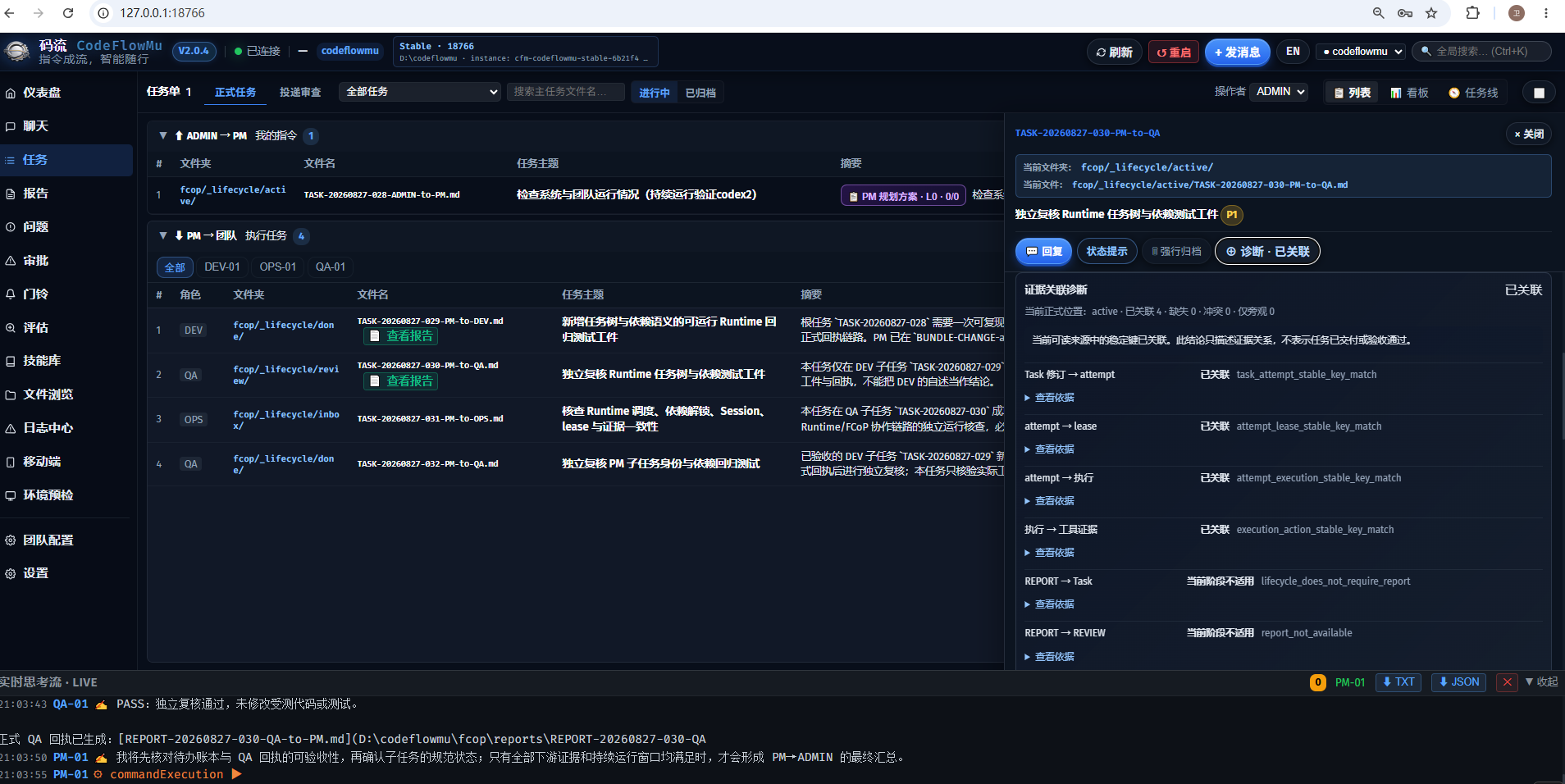
Figure 1. The same QA task is still active. Its revision, attempt, lease, execution, and action evidence can be connected. A formal REPORT has not yet been produced, so REPORT relations are not applicable, rather than missing.
Stage B: review — REPORT relationships become linked when the evidence exists
After the same task enters review, the diagnostic recomputes the graph:
- attempt → lease: linked
- attempt → execution: linked
- execution → action evidence: linked
- REPORT → Task: linked
- REPORT → REVIEW: linked
The remaining EVAL edge is:
EVAL → REVIEW:not_applicable/eval_not_present
That is also the correct result. This is a QA task. In the current workflow, EVAL belongs to the PM path, so this QA task is not expected to carry an EVAL report.
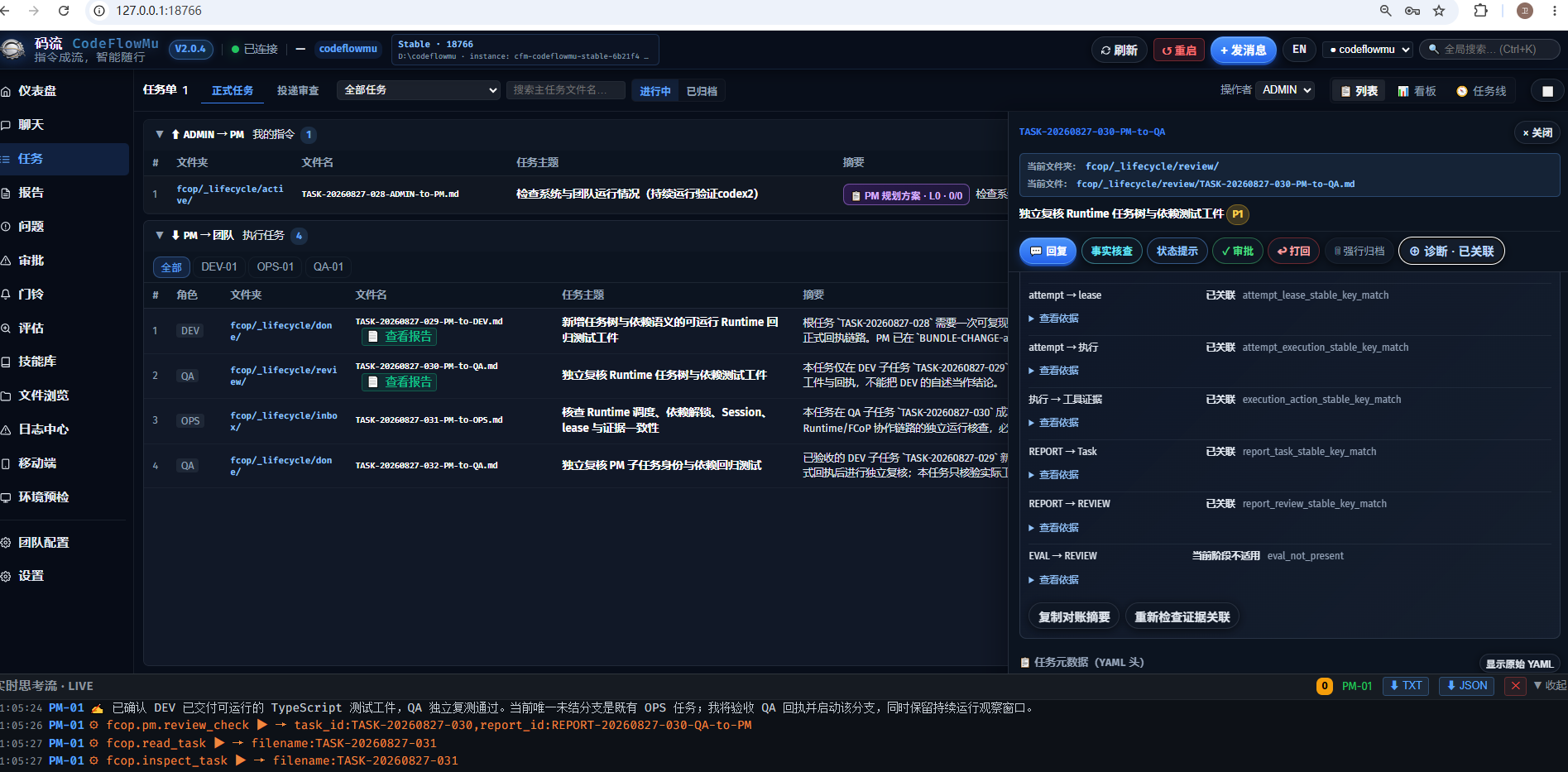
Figure 2. Once the same task reaches review, the diagnostic rereads the formal facts. REPORT → Task and REPORT → REVIEW move from not applicable to linked; EVAL remains not applicable because this QA path does not require one.
The pair therefore demonstrates a specific production capability:
Evidence requirements change with lifecycle stage and role, and the diagnostic changes with the formal facts instead of forcing every edge into linked or missing.
6. not_applicable is a first-class semantic state
A useful agent-runtime diagnostic needs more than healthy/unhealthy.
Evidence requirements are stage- and role-dependent:
- while a task is active, a final REPORT may not yet be required;
- in review, REPORT and REVIEW relationships become relevant;
- a QA task may legitimately have no PM-path EVAL.
The diagnostic therefore distinguishes at least:
linked: explicit stable keys establish the relation;missing: the current stage requires evidence that was not found;conflict: comparable explicit facts disagree;not_applicable: this stage or role does not require the relation;observer_only: an observation exists but carries no lifecycle authority.
This is not UI decoration. It is part of the semantic contract.
7. The most important boundary in the UI
The V2.0.4 task detail states:
This conclusion describes evidence relationships only. It does not mean the task has been delivered or verified successfully.
That sentence prevents evidence association from becoming hidden adjudication.
REPORT → REVIEW = linked establishes only that the current formal REPORT and REVIEW are connected by the relevant stable keys.
It does not establish that:
- the REPORT is truthful;
- the REVIEW conclusion is correct;
- QA has passed;
- ADMIN accepted delivery;
- the task is eligible for
done.
Evidence association is an observation layer. Delivery and acceptance remain separate decisions.
8. Two practical actions make it an engineering tool
The review-stage UI also exposes:
- copy reconciliation summary;
- recheck evidence association.
The first helps operators carry the current relationship state into further review without reconstructing it from logs.
The second forces the diagnostic to reread current formal facts and recompute the snapshot rather than treating cached output as permanent truth.
Neither action changes formal lifecycle state.
That is why V2.0.4 adds more than a task-detail view. It adds an operational evidence-association diagnostic.
9. Why this is a genuine research-to-engineering case
The sequence matters:
Step 1 — historical research. Ten reports yielded 4 linked / 4 missing / 2 conflict and the finding that lifecycle position is not evidence ownership.
Step 2 — engineering contract. TASK, attempt, lease, execution, action, REPORT, REVIEW, and EVAL became explicit relationship edges.
Step 3 — real-task calibration during development. We refined which revisions can be compared, which keys establish REPORT ownership, how execution may be projected, and how the current final REPORT is anchored.
Step 4 — formal V2.0.4 release. The diagnostic became a shipped product capability.
Step 5 — live lifecycle validation. The same QA task moved from active to review: REPORT edges were correctly not applicable before the report existed, became linked when review evidence appeared, and EVAL remained not applicable because this QA path does not require it.
That is the research value: the theory survived contact with the real data model, lifecycle, roles, and runtime state required to become a usable product capability.
10. Public verification
The complete R2 → CodeFlowMu V2.0.4 engineering evidence pack is published separately.
The historical research artifacts remain public:
The V2.0.4 live comparison also has a structured transcript and consistency check:
The two first-party UI screenshots are embedded above. The structured artifacts preserve the stage, visible edges, statuses, and reason codes in machine-checkable form.
Conclusion
R2 began by asking whether REPORTs could be cross-booked.
By V2.0.4, the more useful question is:
Can the runtime keep answering, as the task changes stage, which evidence relationships are established, which are absent, and which are simply not applicable?
The two views of the same QA task show that it can:
- no REPORT during
active→ correctly not applicable; - REPORT and REVIEW present in
review→ linked; - no PM-path EVAL on this QA task → correctly not applicable;
- evidence association remains separate from delivery and acceptance.
An evidence diagnostic is not a static status label. It continuously answers which relationships can be proven from the formal facts that exist now.
That is the engineering capability the original research finding became.
Sources and evidence boundary
- CrewAI #7115 was merged on August 27, 2026. This article uses it only as an independent public engineering reference for keeping creation attempts distinct from confirmed creations. The PR’s 76,015-event / zero-UUID observation is source-reported and was not independently reproduced here.
- CrewAI #7118 remains open at the time of this review. It is cited only as directional public material about a separate terminal record, not as a merged or shipped CrewAI capability.
- CrewAI and CodeFlowMu are not presented here as one implementation lineage. CrewAI does not prove R2 correct, and R2 is not used to judge CrewAI product quality.
- The historical
4 / 4 / 2result comes from one fixed ten-report deidentified slice. It is not a defect rate or system-wide quality measure. TASK-20260827-024is used only as a development-stage calibration case for evidence semantics and formal anchors; this article does not present normal development work as a released-product failure.TASK-20260827-030-PM-to-QAis a first-party V2.0.4 same-taskactive → reviewobservation used to demonstrate stage- and role-aware dynamic diagnosis.- Claims remain scoped to the disclosed tasks, visible edges, and published artifacts rather than all tasks or all desktop/PWA paths.