
When Agents Enter the Enterprise Network: What Do Cursor Self-Hosted Machines Change?
An enterprise can let a cloud Agent work on its own machines without moving its entire development environment elsewhere.
That may sound like another form of remote access. For a local Agent product, however, a more consequential change is emerging: the execution location can return to the enterprise while the entry point that organizes the work—and the loop that controls it—remain with the platform.
On September 2, 2026, Cursor announced an update to Self-Hosted Machines. Cursor is Anysphere’s AI coding product; this update concerns its Cloud Agents, not merely code completion in the editor. It brings personal machines, team worker pools, dynamic capacity, and hibernation/reconnection into one product direction, with computer use on Linux and Mac. Official announcement
This does not establish the inevitable future of digital employees. It does give us a reason to revisit a competitive assumption: when major Agent platforms can also execute on an enterprise’s own machines, how much differentiation can “runs locally” provide on its own?
1. This does not put the entire Agent inside the enterprise
First, identify what actually moved.
Cursor’s documentation draws the boundary directly: the Agent loop, reasoning, and planning remain in Cursor Cloud; the enterprise worker handles file editing, terminal commands, computer-use tools, and local MCP servers. Here, MCP is an interface for connecting Agents to tools and data sources—not proof that a business system has been correctly understood. Self-Hosted Machines overview
An enterprise machine can therefore become more than a developer’s personal computer: it can be an execution location called by the platform. The platform need not own the machine to send tool calls into it and use their results to choose the next step.
Several questions often bundled together under “private deployment” need separate answers:
| Question | What it actually determines |
|---|---|
| Where do tools execute? | Where commands, file operations, and internal-network access happen |
| Where does work information flow? | Which code snippets, outputs, and screenshots enter external reasoning or storage |
| Who controls the execution loop? | Who receives tasks, chooses the next step, and organizes follow-up interaction |
| Who accepts the deliverable? | Who makes the final decisions on authorization, acceptance, and business responsibility |
A machine inside the enterprise answers the first question. It does not automatically answer the other three.
The documentation does not claim that all information stays inside the network. Full checkouts, build caches, and machine-local credentials remain on the worker, but file contents needed by the Agent, terminal output, diffs, screenshots, and MCP results can flow back; some run artifacts are uploaded as well. Privacy Mode’s “not used for training” cannot be read as “not transmitted.” What leaves your network
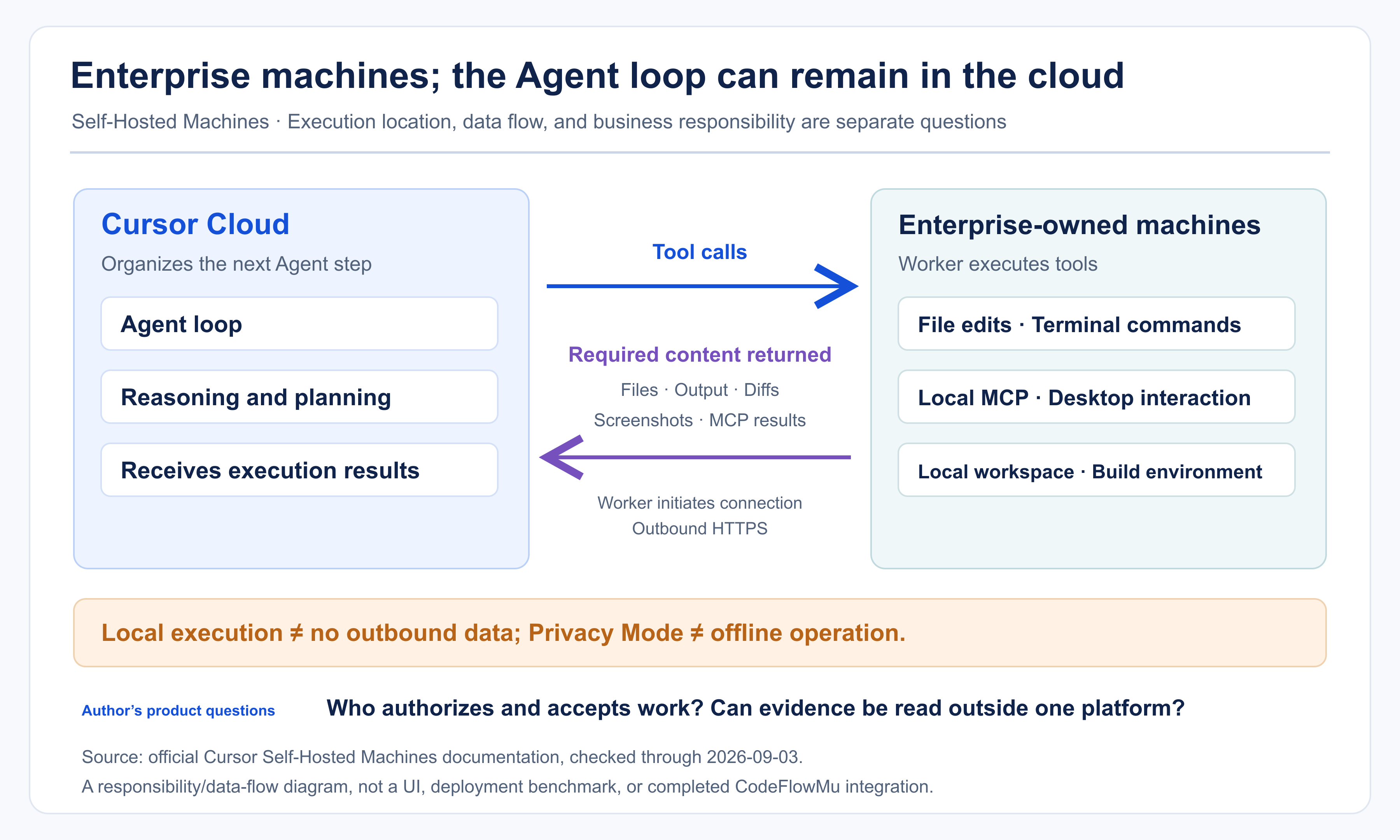
Figure 1 | Responsibilities and data flow based on official documentation. The worker initiates the connection; calls and results travel in both directions over it. The questions at the bottom are the author’s product questions, not evidence of deployment, benchmarking, or a completed CodeFlowMu integration. Open the full-resolution image.
This is not a dismissal of the design. It addresses a real requirement: tools must be close to internal systems, but controlled content may participate in cloud reasoning. A different requirement—reasoning must also remain internal, or content must never leave the network—is not automatically satisfied by the word “Self-Hosted.”
Product analysis should move from deployment labels to these four concrete answers.
2. The important change: machines become allocatable work resources
Connecting your own computer is still close to a personal tool. A team machine pool starts to change how work is organized.
In Cursor Team Pools, requests enter a named pool and available workers claim them. If a follow-up arrives while the original machine is offline, a configured reconnect window can allow time for it to return. Preserving the workspace, however, requires a snapshot, the same worker identity, and cooperation from the deployment controller. The default reconnect window is zero. “Supports hibernation and reconnection” must not become “any disconnected machine can always resume unconditionally.” Team Pool lifecycle and hibernation
The product significance is that users can begin choosing a class of execution conditions, rather than permanently choosing one particular machine.
For example, a team might need workers with an internal build environment, while another task needs a Mac. These are illustrative deployment scenarios, not customer usage data we measured. The key is not the number of machines: execution resources can increasingly be organized around the work.
Looking ahead from this structure, using an Agent could evolve from “ask an assistant on my computer” to “submit work to an enterprise system that allocates execution capacity.” A person proposes the task; the system finds an appropriate environment; an executor temporarily occupies resources; during a wait, the system decides what to preserve and what to reclaim.
That direction also requires a distinction: replaceable machines do not imply freely replaceable executors already carrying responsibility.
A queued new task can look for available capacity. A task that has already run carries workspace state, earlier actions, and current permissions. Resource scheduling answers “where can this run?” It does not inherently answer “which actions may be repeated after the executor changes?”
This is not an allegation that Cursor has a duplicate-execution bug; we performed no such experiment. It is a product boundary that long-running Agent systems need to explain as machine pools become routine.
3. Computer use is more than another tool
On supported Linux and Mac desktops, self-hosted Cursor workers can click, type, and take screenshots. People can watch and take control of the desktop. Computer use and desktop sharing
For an enterprise, this expands what an Agent can reach beyond systems with ready-made APIs. A graphical-only tool can potentially become part of a workflow.
But wider interface coverage does not automatically produce more trustworthy delivery.
Opening a form does not mean knowing which organization to select. Clicking Submit does not establish authority to submit. Seeing a success page does not necessarily complete downstream business reconciliation. These are not claims of Cursor defects; they explain why “digital employee” capability cannot be measured solely by counting tool types.
I find human takeover particularly important. A viable direction need not maximize the elimination of human intervention. It can instead make intervention a normal part of work: machines handle repeatable operations; people handle ambiguity, responsibility, and high-impact decisions; the permitted boundary for subsequent execution is then explicitly returned to the system.
The value is not only how many steps finish automatically. When a person is needed, can the system explain what led there, rather than leave behind only a stalled desktop?
4. CodeFlowMu must ask more than “is this our execution tool?”
CodeFlowMu is a local multi-Agent collaboration system we are developing. FCoP is its convention for organizing work files and role responsibilities—TASK, REPORT, REVIEW, and EVAL. Its concern is not only launching a model call, but also how work is handed over, who checks the result, and what makes a decision justified.
Previously, it was easy to assess platforms such as Cursor mainly as Hosts: can we integrate the SDK, is the CLI stable, are models available? Those questions remain important, but they are no longer sufficient.
When the same platform supplies enterprise execution locations, machine pools, and human work interfaces, it can also enter the work-organization space previously occupied by surrounding systems. It can be both an execution capability used by CodeFlowMu and a competitor for some of the same user needs. This is an analysis of product responsibilities, not a market-share or revenue forecast.
Accordingly, “we run locally too,” “you can view tasks from a phone,” and “we provide isolated workspaces” need fresh scrutiny as differentiators. Useful is not the same as scarce, nor does it establish why a user should bear the cost of another system.
The direction worth testing for CodeFlowMu is not copying each new machine-pool menu. It is whether work responsibilities remain clear outside a particular execution platform:
First, can the execution platform change without fragmenting task identity?
When different Agents or Hosts participate in one TASK, can deliverables, inspection records, and responsibilities remain aligned? The goal is continuity of work records—not a promise to move any platform’s internal session state losslessly. The latter requires platform support; a unified interface cannot guarantee it.
Second, can an Agent’s completion report remain separate from independent acceptance?
What does each observation prove: the executor says it is done, a tool returns success, or a reviewer accepts the result? If CodeFlowMu merely restyles a platform’s success indicator, it adds little delivery value.
Third, can the enterprise retain an auditable chain of decisions?
Who authorized an action, which task revision it applied to, why work later paused or resumed, and how observer evidence differs from formal decisions should be reviewable—not something reconstructed by guessing from a conversation.
These are not all established competitive advantages. This round of source inspection and experiments on V2.2.6 confirmed some existing capabilities and exposed local gaps in Host verification completeness and executor-owner checks. The two accompanying articles provide controlled evidence. They do not establish mature cross-Host work migration or show that CodeFlowMu is inherently more reliable than the platforms. Research and evidence boundaries
Writing down differentiation is easy. Turning it into a benefit users can verify is harder.
5. Many enterprises may not need another layer
If a team mainly needs coding tasks completed in a controlled environment, and one platform already satisfies its permission, review, and delivery requirements, a cross-platform governance system may simply add configuration, another set of states, and another boundary to debug.
CodeFlowMu must accept that counterargument instead of evading it with “every enterprise needs governance.”
Cursor itself does not recommend self-hosting for every team. Its documentation favors the managed option when it meets requirements; self-hosting also makes the customer responsible for machines and operations. Deployment choice and operating responsibilities
It would therefore be premature to claim that all Agents will eventually move back into enterprise server rooms. A more defensible outlook is: execution location becomes a configurable condition, selected alongside network access, environment, responsibility, and cost. Product competition centers on making that combination usable, trustworthy, and sustainable.
For small teams, reduced maintenance may matter more than machine ownership. For specialized environments, execution location may be a hard requirement. For cross-department or cross-platform work, long-lived task identity and independent acceptance may matter more. This is a segmentation of possible needs, not a conclusion from market research we conducted.
Openness and integration are not free advantages, either. Platforms differ in session semantics, permission boundaries, and result formats. If compatibility costs exceed the benefit of substitution, supporting more Hosts can make a system harder to maintain.
Whether an integration or governance capability deserves investment must therefore return to actual work. What manual reconciliation does it remove? Which otherwise-lost responsibility chain does it preserve? During interruptions, does it really reduce mistaken execution or waiting? Without that evidence, a competitor’s update should not automatically trigger a matching development project.
6. The longer-term question: who organizes and accepts Agent work?
This update makes three possibilities more persuasive to me. They are forecasts, not official roadmap commitments.
First, execution infrastructure may become a standard platform capability rather than the strongest selling point of an independent Agent product. Whoever owns the task entry point has an incentive to reach more customer environments. Who purchases the machine need not determine who organizes the work.
Second, long-lived work capability may matter more than one-shot demonstrations. A successful click is easy to demonstrate. Correctly understanding and handling a task across waiting, hibernation, human takeover, and environment changes is closer to a real job. Machine pools and workspace recovery bring that issue into the product foreground; they do not automatically close every responsibility boundary.
Third, enterprise control may shift from “who owns the server?” toward “can work facts and decisions be explained outside a single platform?” If changing execution providers makes it impossible to explain why an old task was authorized or who reviewed its artifacts, owning the machine does not necessarily provide full work continuity.
These possibilities need observation, not an early declaration of winners. The most useful future evidence is not another tool count, but delivery cost under real workloads, human-intervention burden, recovery behavior, and whether people outside the platform can understand task evidence.
This article did not deploy a Cursor worker, measure pool costs or recovery success rates, or compare market performance. It uses official releases and documentation checked through September 3, 2026, to advance a product judgment worth taking seriously:
Cursor is not merely making it easier for Agents to reach enterprise machines. It is also making enterprise machines easier to use as platform execution resources.
For CodeFlowMu, the position worth pursuing is therefore not just “where else can it run?” It is whether, when executors, machines, or even platforms change, an enterprise can still answer clearly: whose task is this, what authorizes its execution, and who accepts the result?